
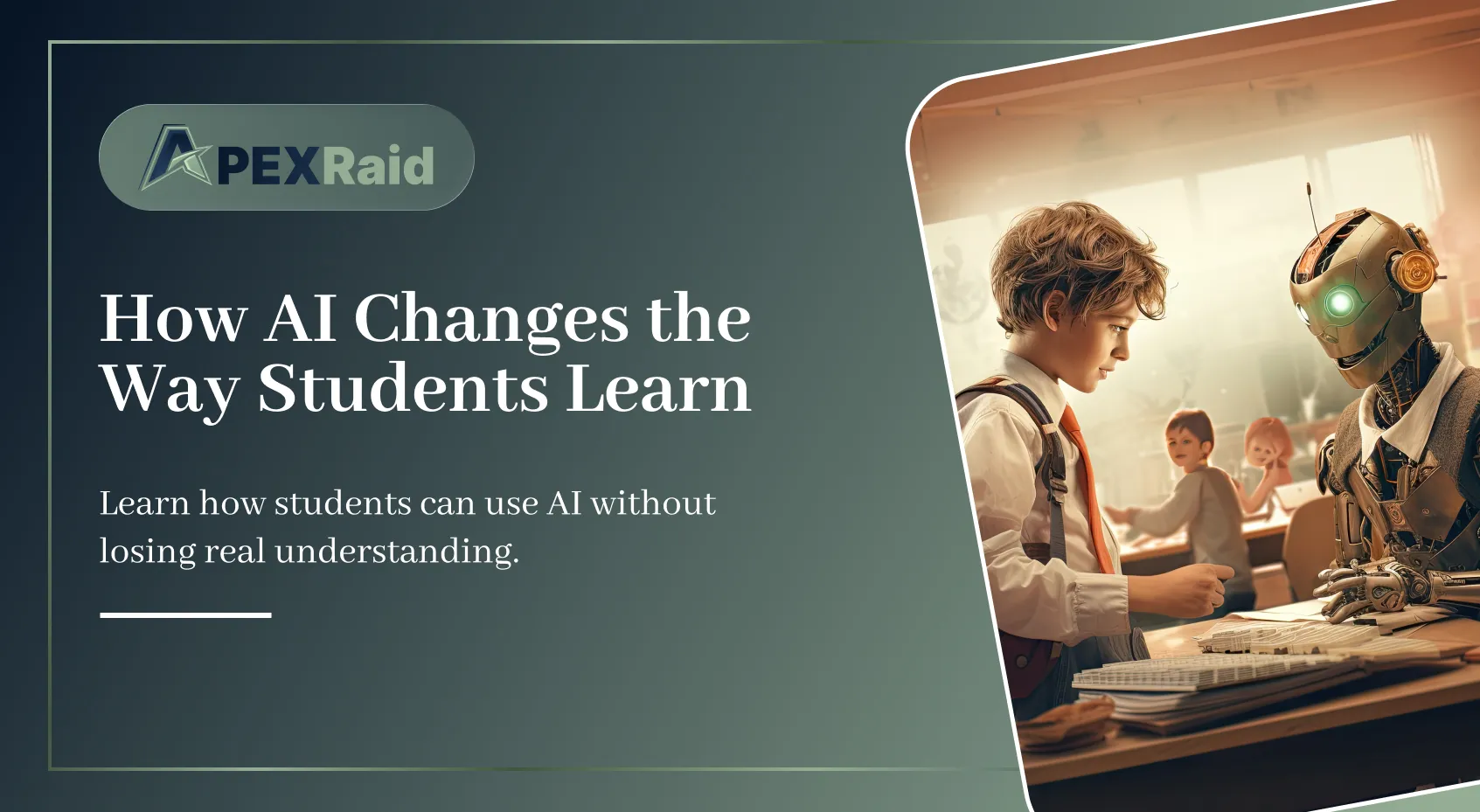
Education has always evolved alongside technology. The printing press made knowledge portable. Radio and television brought lectures into homes. The internet made information universally accessible. Each shift changed what students needed to know and how they learned it. Artificial intelligence represents the next such shift — and unlike previous waves, it is capable of adapting to individual learners in real time. Research from the OECD identifies AI as one of the most significant drivers of educational change in the 21st century, with the potential to transform both what is taught and how it is delivered.
This is not a distant prospect. AI tools are already inside classrooms, embedded in learning platforms, and sitting on the devices students use every day. Understanding what these tools actually do — and what they cannot do — is essential for anyone studying or teaching in this environment. A 2023 review published in the Journal of Educational Technology found that over 70% of US school districts now use at least one AI-powered educational platform, and adoption is accelerating rapidly.
What AI in Education Actually Means
When people say AI is changing education, they typically mean a category of software that uses machine learning to adjust its behaviour based on data. In a classroom context, this usually falls into one of three categories: personalised learning platforms, intelligent tutoring systems, and AI-assisted assessment.
A personalised learning platform tracks how a student answers questions and adjusts the difficulty and topic of future questions accordingly. If a student consistently gets algebra problems right but struggles with geometry, the system routes more geometry practice their way. This is not a teacher making that judgment — it is an algorithm identifying patterns across thousands of responses. Platforms like Khan Academy's AI-powered features and DreamBox Learning are examples of this approach, each using different algorithmic architectures to achieve similar goals.
Intelligent tutoring systems go a step further. They simulate a one-on-one tutoring experience by diagnosing the specific nature of a student's mistake, not just whether an answer was right or wrong. A student who confuses the order of operations in an arithmetic problem gets different feedback than one who made a simple arithmetic error on an otherwise correct method. Research on intelligent tutoring systems has been ongoing since the 1970s, with early pioneers like John Anderson at Carnegie Mellon University laying the groundwork for today's more sophisticated systems.
AI-assisted assessment uses natural language processing to evaluate written work. These systems can flag grammatical errors, assess argument structure, and even estimate whether a piece of writing demonstrates understanding of the topic. They are increasingly used to give instant first-pass feedback on essays before a human teacher reviews the work.
The Evidence on Personalised Learning
Personalised learning is perhaps the most studied application of AI in education. The results are cautiously promising. A 2019 study published in npj Science of Learning found that students using adaptive learning platforms showed measurably better retention on spaced-repetition tasks compared to students using fixed study schedules. The personalised timing of review sessions, driven by algorithms that predicted when a student was likely to forget a concept, produced a meaningful advantage over one-size-fits-all review. The study involved over 1,500 students across multiple institutions and found effect sizes of approximately 0.3 standard deviations for the adaptive group — a moderate but educationally significant advantage.
However, results across different implementations vary significantly. Much depends on whether the adaptive system is well-calibrated to the curriculum, whether teachers use the data it generates to inform their instruction, and whether students are motivated to engage honestly with the material rather than gaming the system to get easier questions. A meta-analysis published in the Journal of Educational Psychology found that adaptive learning platforms produce the greatest benefits when combined with teacher-led instruction, suggesting that the technology is most effective as a supplement rather than a replacement.
Carnegie Learning's MATHia platform, used in thousands of US schools, is among the most extensively researched adaptive math tools. Independent evaluations have found positive effects on algebra performance, particularly for students who were already slightly below grade level. For students performing well above or well below average, the benefits were less consistent. This suggests adaptive AI works best as a support tool rather than a replacement for differentiated human instruction.
AI Tutors and the Socratic Method Problem
One of the oldest and most effective teaching techniques is Socratic questioning — guiding a student to an answer through a sequence of carefully chosen questions rather than simply providing the explanation. Human tutors do this naturally, reading a student's confusion and adjusting their approach in response to verbal and non-verbal cues.
Current AI tutors can approximate this in limited domains. Systems like Khan Academy's Khanmigo, which is powered by large language model technology, are designed to respond to student questions with guiding questions rather than direct answers, pushing students to reason through problems rather than passively receive information. The results reported by Khan Academy are encouraging — students who engaged with the tutoring feature spent significantly more time actively problem-solving compared to students who simply watched the video lessons. Early internal evaluations suggest that Khanmigo users demonstrate improved problem-solving persistence and more accurate self-assessment of their understanding.
But there are important limits. AI tutors cannot yet reliably detect the difference between a student who is productively struggling with a hard concept and a student who is disengaged and frustrated to the point of giving up. The distinction requires reading emotional state, context, and motivation — areas where human teachers still hold a decisive advantage. Research on AI tutoring limitations has found that current systems are poor at detecting confusion and frustration, often misinterpreting these states as evidence of engagement and continuing to push the student harder rather than offering support.
Automated Essay Grading: Useful, But Incomplete
Automated essay scoring (AES) tools have existed since the 1960s, but recent advances in large language models have made them substantially more capable. Modern systems can evaluate coherence, vocabulary range, sentence variety, and argument structure with reasonable accuracy on standardised prompts where the expected content is well-defined. Research on AES accuracy has shown that state-of-the-art systems achieve correlations with human judges of 0.7 to 0.9 on standardised tests, comparable to the level of agreement between human raters.
Their limitations become apparent on open-ended creative or analytical tasks. AES tools tend to reward length and vocabulary over quality of reasoning. A well-researched study found that students coached to write longer essays with more sophisticated vocabulary — even at the expense of logical coherence — consistently scored higher on automated assessments than on human-graded versions of the same work. This creates a perverse incentive: students learn to optimise for the machine rather than to write better.
The appropriate use of AES appears to be as a first-pass tool that gives students immediate feedback on mechanical elements — grammar, structure, length — while human marking addresses the substance of the argument. Several universities now use this hybrid model, and educators report that the immediate feedback loop encourages students to revise their work more frequently than they would if they had to wait for a human review.
How AI Is Changing What Students Need to Learn
Beyond specific tools, AI is changing the landscape of skills that have educational value. Tasks that were once considered core academic competencies — summarising a text, producing a first draft, translating between languages — can now be performed quickly by AI systems. This raises a question that educators are actively debating: what should students learn how to do when a machine can do it for them?
The answer that is emerging, tentatively, is that AI changes the ceiling of what students must understand, not the floor. A student who cannot read critically cannot effectively evaluate an AI-generated summary. A student who has never constructed an argument from evidence cannot identify when an AI-generated essay misrepresents a source. The baseline competencies — reading, reasoning, writing, arithmetic — remain as important as ever, because they are the tools students need to work with AI outputs rather than simply consume them. Research on the future of work in education consistently identifies critical thinking, creativity, and interpersonal communication as the skills most likely to remain valuable as AI capabilities expand.
What changes is the emphasis on higher-order skills: evaluating sources, identifying logical errors, constructing original arguments, and synthesising information from multiple conflicting accounts. These are tasks where AI still performs poorly compared to a trained human thinker, and they are therefore the skills that will have lasting value as AI becomes more capable at the mechanical parts of academic work.
The Neuroscience of AI-Assisted Learning
Understanding how AI-assisted learning affects the brain provides important insights into its potential and its limits. Research on cognitive load theory suggests that AI tools can reduce extraneous cognitive load — the mental effort required to navigate poorly designed instruction — allowing students to focus more on germane processing, the actual work of understanding. This is the mechanism by which adaptive platforms may improve learning outcomes: they reduce the cognitive friction that comes with poorly sequenced or overly challenging material.
However, the same research also raises a concern: if AI tools reduce cognitive load too much, they may also reduce the productive struggle that is essential for deep learning. Research on desirable difficulties has shown that learning is most durable when it requires effort — when students have to work to retrieve information, to apply concepts in novel contexts, and to persist through confusion. AI tools that make learning too easy may inadvertently weaken the encoding processes that make learning stick.
The Risk of Passive Learning
One of the more subtle risks introduced by AI tutoring tools is the potential to reduce the productive struggle that research consistently identifies as a key driver of learning. Struggle — the experience of genuinely not knowing and working toward understanding — is cognitively demanding but appears to be important for consolidating knowledge into long-term memory. Research on productive struggle has found that students who persist through difficulty demonstrate better retention and transfer than those who are given immediate assistance.
If an AI system is too responsive, providing hints or answers at the first sign of difficulty, students may develop a habit of reaching for the prompt rather than sitting with uncertainty long enough to develop genuine understanding. This is not a hypothetical concern. Researchers studying digital homework platforms have found that students who use the hint systems heavily tend to perform worse on subsequent assessments than students who attempt questions without hints, even when both groups ultimately get the answers right. A 2022 study in the Journal of Learning Sciences found that students who overused hints on an adaptive math platform showed less improvement over the course of the semester, as measured by both platform data and standardised test scores.
The implication for educators is that AI tools in education need to be deliberately calibrated to allow productive difficulty, not just optimise for correct answers. A system that always moves a student toward the right answer efficiently may be teaching compliance rather than thinking.
The Role of Generative AI (ChatGPT) in Education
The arrival of large language models like ChatGPT in late 2022 represented a watershed moment in AI and education. For the first time, students gained access to a tool that could generate coherent, contextually appropriate text on virtually any topic, answer complex questions, and even provide explanations tailored to different levels of understanding. This has created both unprecedented opportunities and significant challenges.
Research on generative AI in education is still emerging, but early studies suggest that students can use LLMs effectively for brainstorming, generating first drafts, and checking their understanding. However, there are significant concerns about academic integrity, with many institutions reporting increased instances of AI-generated submissions presented as original work. The most promising pedagogical response appears to be a shift toward assessment that emphasises process over product — evaluating students on their ability to refine, critique, and build upon AI-generated content rather than simply producing original content from scratch.
A 2024 study examining ChatGPT use in university courses found that students who used the tool to generate first drafts and then revised them critically produced higher-quality final submissions than students who wrote entirely independently. The key was the critical revision phase — students who simply submitted the AI output without significant revision produced work that was poor, while students who used the AI as a collaborator and critic produced the best work of all.
Teacher Roles in an AI-Assisted Classroom
The most common concern raised about AI in education is whether it will replace teachers. The evidence suggests the opposite is more likely: AI makes the teacher's role more important in some respects and frees them from lower-value tasks in others. Research on teacher-AI collaboration has found that the most effective models are those where AI handles routine tasks and data analysis, allowing teachers to focus on high-value interactions with students.
AI can handle the repetitive, high-volume feedback tasks that consume significant teacher time: marking multiple-choice assessments, identifying patterns in student error data, generating practice exercises at different difficulty levels. A teacher who previously spent three hours marking a set of arithmetic tests can potentially redirect that time toward direct instruction, small-group support, or addressing the specific misconceptions the AI flagged.
What AI cannot replace is the relational dimension of teaching. Motivation, belonging, accountability, and the understanding that someone believes in a student's potential — these are not features that can be productively automated. Research on student achievement consistently identifies the teacher-student relationship as one of the strongest predictors of academic progress, with effect sizes comparable to those of whole-school interventions. AI tools that free up teacher time for those interactions are likely to have a bigger impact on learning than AI tools that try to replicate them.
Evidence from Large-Scale Implementations
Beyond individual studies, the adoption of AI in education at scale provides valuable evidence about what works and what does not. A comprehensive review of large-scale implementations in the United States and Europe found that the most successful programs shared several characteristics: they were implemented over multiple years, they involved significant teacher training, and they integrated AI tools into existing curricular structures rather than treating them as standalone interventions.
In the United Kingdom, the UCL Institute of Education's research on AI in schools found that schools that implemented adaptive learning platforms with ongoing professional development for teachers saw significant improvements in student outcomes, while schools that deployed the same technology without the training component saw little change.
Perhaps the most significant finding from large-scale implementations is that AI tools do not eliminate the need for strong pedagogy. They amplify the effectiveness of good teaching but cannot compensate for poor teaching. This suggests that investment in AI should not come at the expense of investment in teacher quality and professional development.
Equity Considerations
Any technology that improves access to personalised, high-quality educational support has the potential to reduce inequality. An intelligent tutoring system available to a student in a rural school with limited staffing could theoretically provide the kind of individualised support that was previously only available to students at well-resourced schools. This is a genuine opportunity.
In practice, AI-driven educational tools require reliable internet access, up-to-date devices, and institutional support for teachers to use the data effectively. Schools with fewer resources are often less well-positioned to implement these tools well, which means AI could initially widen rather than narrow educational inequality if access and implementation quality are not specifically addressed. Research on the equity implications of AI in education has found that well-resourced schools are significantly more likely to adopt AI tools effectively, potentially widening achievement gaps if the technology is not deployed with explicit equity goals.
Several organisations are working on this problem directly. The Gates Foundation and the Chan Zuckerberg Initiative have both funded initiatives to deploy adaptive learning tools in under-resourced schools, with mixed but generally positive early results. The key finding across these programmes is that technology alone does not improve learning — it is the combination of good tools, well-trained teachers, and sustained institutional support that produces meaningful change.
What Students Can Do Now
For students navigating an education system increasingly shaped by AI, a few practices stand out as particularly valuable. First, use AI tools as a supplement to active thinking, not a replacement for it. If an AI tutor offers a hint, try answering without the hint first and check it afterward. If an AI tool drafts an essay, use the draft as a starting point for critical evaluation rather than a finished product. Research on student strategies for AI use has found that the most successful students treat AI as a collaborator and critic, not as a substitute for thinking.
Second, develop the skills AI handles poorly: sustained argument, source evaluation, and original synthesis. These are the skills that will distinguish capable thinkers from capable AI users in the years ahead.
Third, pay attention to how you are using AI tools and whether they are genuinely improving your understanding or just helping you get assignments done. The goal of education is to change what you can do with knowledge, not to produce outputs efficiently. Any tool that serves the former goal is genuinely useful; any tool that serves only the latter is replacing learning with the appearance of learning.
Ethical Considerations and the Future of AI in Education
As AI becomes more deeply embedded in educational systems, a range of ethical considerations comes to the fore. Data privacy is a significant concern: adaptive learning platforms collect vast amounts of data on student performance, learning patterns, and even behavioural indicators. Research on AI ethics in education has raised concerns about the potential for these data to be used for purposes other than educational improvement, or for the algorithms to reinforce existing biases.
Algorithmic bias is another critical concern. AI systems learn from historical data, which may reflect existing disparities in educational outcomes. If an adaptive platform is trained on data from primarily well-resourced schools, it may not serve students from under-resourced backgrounds effectively. Research on algorithmic bias in educational AI has identified specific instances where systems performed less well for students from minority backgrounds, highlighting the importance of careful evaluation and transparency.
Finally, there is the question of who should control the development and deployment of AI in education. If left to private companies, there is a risk that educational goals will be subordinated to commercial interests. Research on the governance of AI in education recommends that public oversight, transparent evaluation, and input from educators and students should be central to the development and implementation of AI tools.
Conclusion
Artificial intelligence is changing education in measurable, significant ways. Adaptive platforms are improving practice efficiency. Intelligent tutors are extending access to individualised feedback. Automated assessment is speeding up the revision cycle. These are real gains. They come with real risks: over-reliance, equity gaps, and the possibility that optimising for AI-measured performance is not the same as developing genuine understanding.
The students and educators who will benefit most from these tools are those who understand both what they offer and where their limits lie — and who use that understanding to direct AI toward the parts of education where it genuinely helps, while protecting the slower, more demanding work of thinking that machines still cannot reliably do.
As research on AI and deep learning has shown, the most effective educational uses of AI are those that use the technology to amplify human strengths, not replace them. This insight should guide both educational policy and individual practice in the years ahead.