
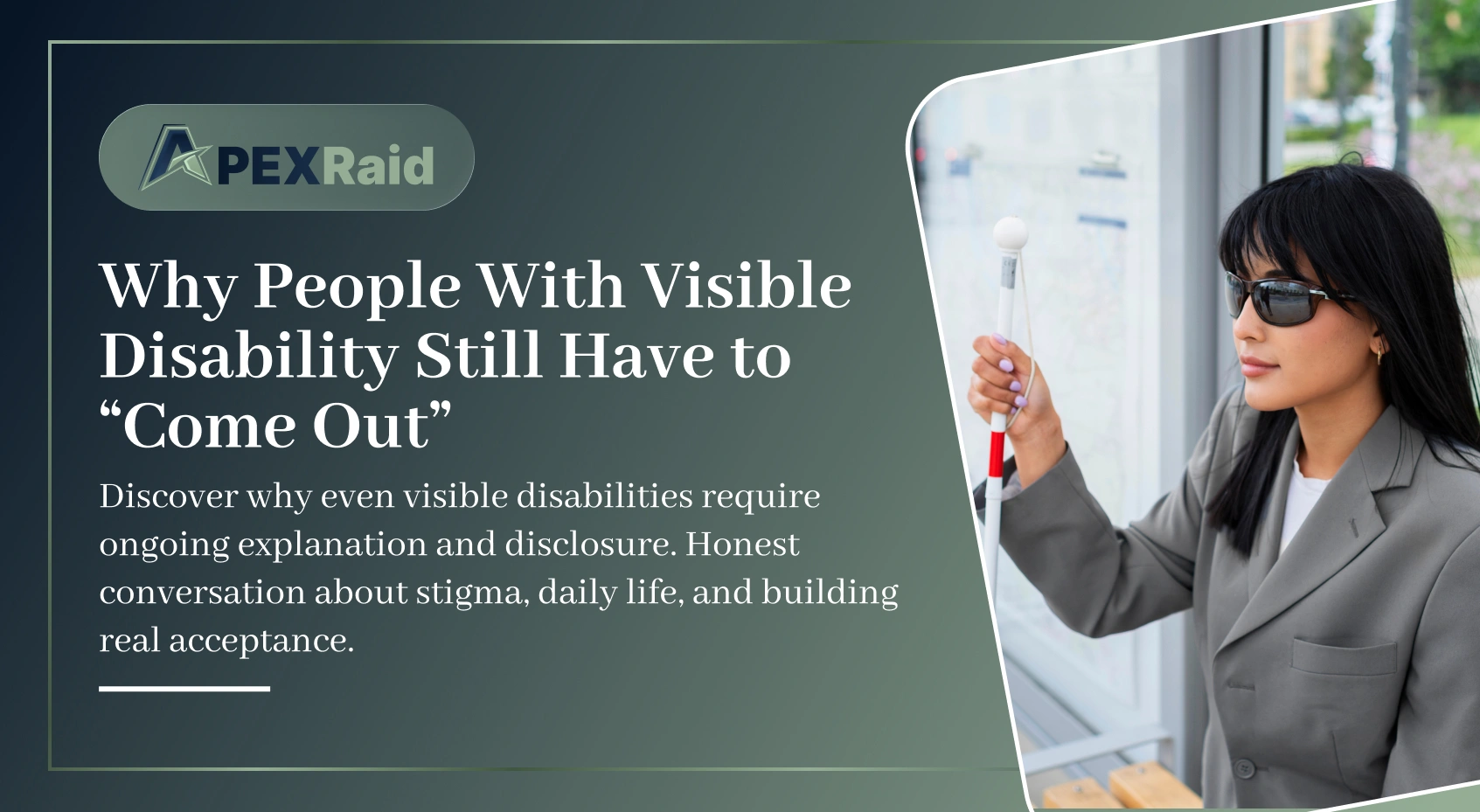
In contemporary sociological discourse, the concept of 'coming out' is almost exclusively associated with the LGBTQ+ community — a definitive, often singular moment of disclosing a marginalised identity to a predominantly normative society. The assumption inherent in this framework is that disclosure is only necessary when an identity is concealed or invisible. However, within disability studies, a paradoxical phenomenon exists: individuals with highly visible disabilities — those who use mobility aids, possess facial differences, have amputations, or utilise service animals — find themselves engaged in a relentless, exhausting, and daily process of 'coming out.'
The visibility of their disability does not preempt the need for explanation; rather, it acts as a magnet for societal interrogation. The wheelchair, the cane, or the prosthetic does not speak for itself in the eyes of the able-bodied public; it demands a narrative. Bogart, Krauter, Cipollina, Wang, Sykes, Garrison, and Harcourt (2026) found that disclosure research has largely focused on invisible stigmatised identities, assuming that for people with visible stigmas there is no need to 'disclose the obvious.' However, their research confirms that people with observable disabilities do face disclosure decisions, precisely because their disabilities are observable.8†L8-L11 Understanding why visibly disabled individuals are constantly forced to narrate their own existence requires examining the medical model of disability, the social mechanics of able-bodied discomfort, and the profound emotional labour required to exist as a visible anomaly in a standardised world.
This guide provides a comprehensive, evidence-based sociological analysis of why visible disability does not eliminate the need for disclosure, exploring the paradox of visibility, the medical and social models of disability, the emotional labour of managing able-bodied discomfort, the concept of covering, and the path toward a more inclusive paradigm.
The Paradox of Visibility and the Demand for Narrative
To be visibly disabled in public is to be subjected to the 'narrative demand.' When an able-bodied individual encounters a visibly disabled person, the visual deviation from the normative human form frequently triggers a cognitive dissonance that society attempts to resolve through inquiry. Disability research has noted that persons with visible impairments are routinely met with preconceived notions others entertain of them by virtue of seeing a sign of impairment.9†L30-L32 The questions are ubiquitous, ranging from the seemingly benign to the deeply intrusive: 'What happened to you?' 'Were you born like that?' 'Does it hurt?' 'Will you ever get better?'
This interrogation is rooted in the medical model of disability, which historically views a disabled body as a tragedy, a defect, or a medical puzzle waiting to be solved. The medical model frames disability as a bodily 'defect', and therefore the responsibility of the disabled person to address or overcome.2†L6-L7 Under this model, the disabled person is not viewed as a complete entity existing in a state of natural human variation, but as a walking diagnostic chart. The able-bodied inquirer feels entitled to the medical history of a stranger because society has conditioned them to view disabled bodies as public property — objects of curiosity rather than subjects of privacy. As disability scholars have noted, visibly disabled bodies are seldom allowed to occupy a drama's centre stage; rather, they function to allow non-disabled characters to demonstrate their generosity and non-disabled spectators to experience their normalcy.
Consequently, the visibly disabled individual is forced to 'come out' not by revealing a hidden truth, but by providing a socially palatable narrative to contextualise their visual presence. They must constantly choose how to frame their identity to strangers: Do they provide the clinical diagnosis? Do they offer an inspirational narrative to make the inquirer comfortable? Do they use humour to deflect? Or do they establish a firm boundary and risk being labelled as 'bitter' or 'aggressive'?
The Emotional Labour of Managing Able-Bodied Discomfort
The daily requirement to narrate one's disability exacts a significant toll in the form of emotional labour. Sociologist Arlie Hochschild defined emotional labour as the management of emotions, primarily to maintain employment.12†L22-L23 For visibly disabled individuals, a primary component of navigating public space involves managing the discomfort, anxiety, or pity of able-bodied people. Jóhannsdóttir and Ágústsdóttir (2025) have identified 'emotional disability work' — forms of work that are often 'invisible, conditional, and an inseparable part of being a disabled person' and that are usually 'carried out as a result of the fear and shame of causing discomfort to others.'11†L9-L12
When a stranger asks an intrusive medical question, the disabled individual must instantly calculate the social dynamic. If they respond with justifiable annoyance, they violate the societal expectation that disabled people should be docile, grateful, and accommodating. To maintain social harmony — whether at the grocery store, in a job interview, or on a first date — the disabled person often assumes the burden of educating the inquirer, soothing their awkwardness, and reassuring them that the disability is not a threat.
Bogart and colleagues (2026) found that threats to disclosure autonomy were common among participants with observable disabilities, who felt compelled to disclose due to access needs or intrusive questions.8†L24-L26 Their study, grounded in Self-Determination Theory, found that autonomous disclosure was associated with positive outcomes like competence and belonging, while compelled disclosure was linked to distress.8†L26-L28 This dynamic forces the disabled individual to constantly monitor and modulate their own identity. They are forced to 'come out' as competent in the workplace, to overcome the subconscious bias that physical disability equates to cognitive inability. Scully (2010) writes that hidden labour is often required of people with disability to manage the perception of their disability or impairment by others, and that this labour 'must be hidden from the nondisabled partner in order to be effective.'12†L49-L52
The Concept of 'Covering' and Social Friction
Legal scholar Kenji Yoshino popularised the concept of 'covering' — the process by which individuals downplay or mute aspects of a stigmatised identity to blend into the mainstream.4†L6-L8 To cover is to downplay a disfavoured trait so as to blend into the mainstream.4†L21-L22 While an individual with an invisible illness might 'pass' entirely by hiding their condition, a visibly disabled person cannot pass. Instead, they engage in covering by minimising the social friction their disability causes.
Covering, in the context of visible disability, looks like laughing off an offensive joke to avoid tension. It looks like apologising for taking up space in a narrow aisle or taking longer to board a bus. It looks like adopting an excessively cheerful demeanor to counteract the societal assumption that disabled lives are inherently tragic. By constantly managing how their visible difference is perceived, the individual is effectively 'coming out' as the 'right kind' of disabled person — one who is inspiring rather than burdensome, compliant rather than demanding. Disability research has noted that highly visible impairments become hyper-visible, eclipsing at least for a time all other identities a person may wish to present.9†L45-L46
The exhaustion of this continuous covering is profound. The disabled individual is denied the privilege of anonymity — the simple, unnoticed existence that able-bodied individuals take for granted when moving through public space. Every interaction carries the potential for an interrogation, forcing a constant state of hyper-vigilance. The 2026 study found that pressure to disclose — from staring and intrusive questions — threatens disclosure autonomy.8†L12-L13 Participants in the study underscored the need for systemic changes, including universal design, to reduce the burden of compelled disclosure.8†L28-L29
The Intersection of Invisible and Visible Realities
The discourse surrounding disability disclosure often highlights the tension between invisible and visible conditions. Individuals with invisible disabilities (such as chronic pain, autoimmune diseases, or neurodivergence) fight a constant battle to be believed, frequently encountering skepticism and the accusation that they are 'faking it' because they 'look fine.' Their disclosure is an attempt to legitimise their need for accommodations. Research on hidden disability identity has found that participants experience the 'Not Disabled Enough' dilemma in which they struggle to claim a disabled identity due to societal attitudes, stigma, and the absence of inclusive language.10†L18-L20
Visibly disabled individuals face the inverse challenge: their disability is universally believed, but it eclipses all other aspects of their identity. The wheelchair or the prosthetic becomes the defining characteristic, a metonym for the entire person. Their continuous 'coming out' is an attempt to broaden the narrative beyond the visual evidence of their impairment. They are fighting to legitimise their multidimensionality. There is a fundamental difference between having visible and invisible impairments, with visible impairments being routinely met with preconceived notions while invisible impairments are not initially assigned subject positions as disabled.9†L28-L33 This research calls for spectrum-based language that reflects the fluid, evolving nature of disability.10†L22-L24
Both struggles stem from the same societal failure: the inability to accept disability as a natural, unexceptional facet of the human experience. Both visible and invisible disabilities require the individual to perform exhausting translation work to make their reality comprehensible to a normative world. The findings underscore the need for systemic changes, including universal design, to reduce the burden of compelled disclosure for all disabled individuals.8†L28-L29
Reframing the Paradigm: The Social Model of Disability
Breaking the cycle of continuous, forced disclosure requires a societal shift from the medical model to the social model of disability. The social model of disability emphasises societal barriers and calls for structural change to promote inclusion.2†L29-L30 Social models tend to emphasise macro-sociological factors as explanations for disability.2†L43-L44 The social model posits that individuals are not disabled primarily by their physiological or cognitive impairments, but by an environment and a society that are constructed exclusively for a standardised, normative body.
If society fully embraced the social model, the presence of a visible disability would not trigger cognitive dissonance or entitle strangers to medical histories. A wheelchair ramp would be viewed as a standard architectural feature, not a special accommodation. A prosthetic limb would be viewed as a tool, not a tragedy. The visible markers of disability would cease to be conversation starters demanding explanation, and would simply fade into the tapestry of everyday human variation. Countries continue to use the Medical Model to define disability in legislation, while the rights enumerated (such as accommodations and access) are informed by the Social Model.2†L8-L10 The tensions between these competing models influence the ways in which we understand disability.2†L22-L24
The social model challenges the framing of disability as a deficiency requiring treatment or rehabilitation, and instead calls for structural change to promote inclusion.2†L28-L30 As Bogart and colleagues (2026) found, universal design is essential to reduce the burden of compelled disclosure.8†L28-L29 When environments are designed to be accessible to all, the need for individuals to constantly explain their presence diminishes.
Conclusion
The ongoing necessity for visibly disabled individuals to 'come out' is a powerful indictment of a society that continues to view physical difference as an anomaly requiring justification. The visibility of a disability does not alleviate the burden of disclosure; it merely shifts the nature of the interrogation. As the research on observable disability disclosure confirms, people with observable disabilities do face disclosure decisions, precisely because their disabilities are observable.8†L10-L11 Until society learns to grant disabled bodies the same rights to privacy, anonymity, and unquestioned presence in public space as able-bodied individuals, the exhausting emotional labour of continuous explanation will remain a defining feature of the disabled experience. Progress relies not on disabled individuals getting better at answering intrusive questions, but on able-bodied society learning to stop asking them.