
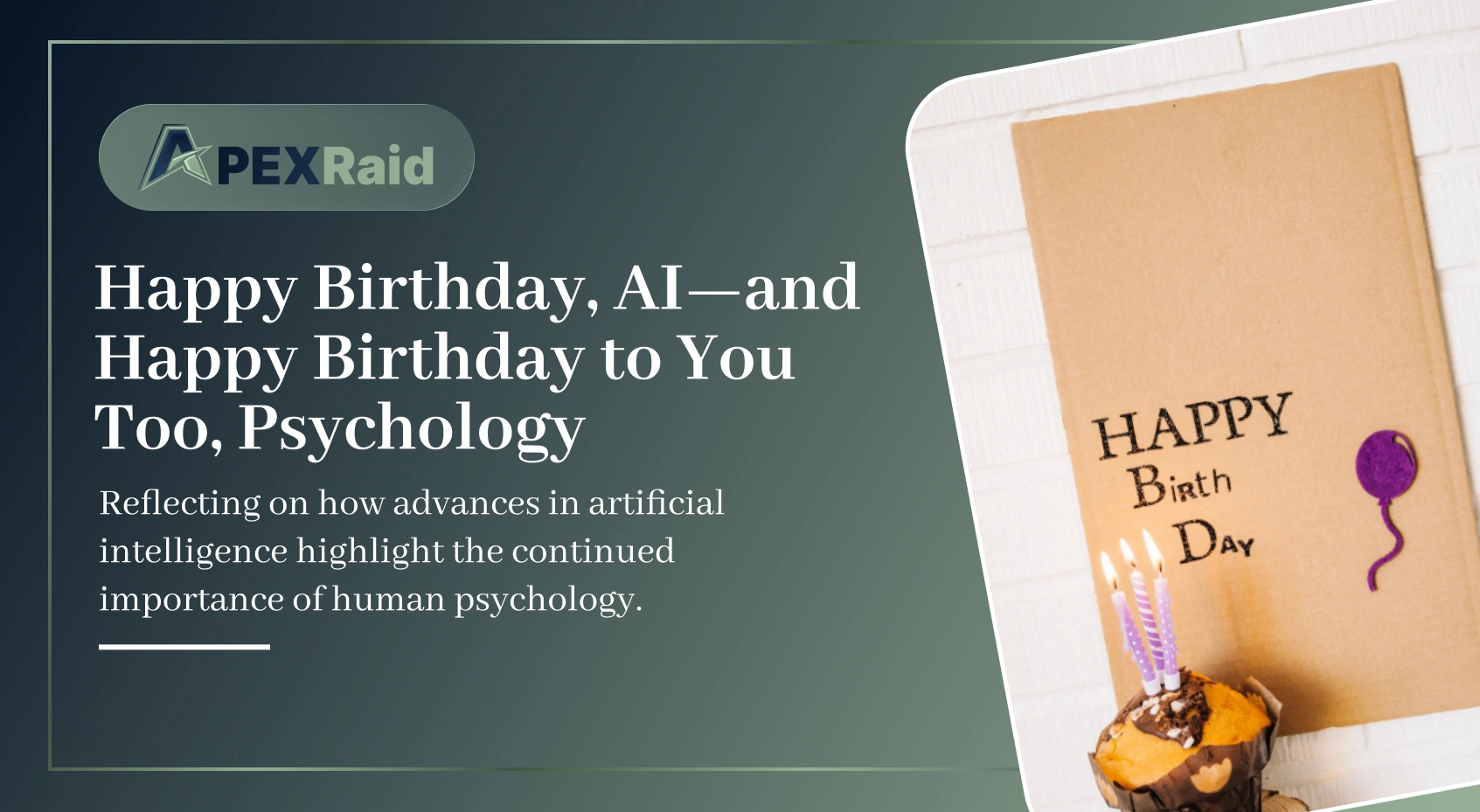
Artificial intelligence and psychology are often talked about like they belong in different worlds. One sounds technical, the other sounds human. But the history of both fields is closely connected, and that connection still shapes the way we think about intelligence today. This relationship is not merely historical curiosity; it is foundational to how we understand both human cognition and machine intelligence. As research in the history of cognitive science demonstrates, the fields of AI and psychology have mutually influenced each other for over seven decades, with each field borrowing concepts, models, and insights from the other in an ongoing intellectual dialogue.
That matters because AI did not appear out of nowhere. A lot of the early thinking behind it borrowed ideas from how people learn, remember, and solve problems. Understanding this shared history helps demystify AI, sets realistic expectations about its capabilities, and highlights the profound questions it raises about the nature of mind and meaning.
How the connection started
When researchers first tried to build machine intelligence, they needed a way to explain thought in practical terms. Psychology was already asking similar questions: How do people learn? How do they remember? How do they choose what to pay attention to? Those questions gave computer scientists useful language for talking about intelligent behavior. The connection was not accidental; it was driven by a shared intellectual project: understanding the nature of intelligence, whether embodied in neurons or circuits.
Once the brain started being described as a system that processes information, computers became a natural model to borrow from. This was the central insight of the Cognitive Revolution of the 1950s and 1960s, which transformed psychology from a behaviorist science focused on observable actions to a cognitive science focused on internal mental processes. That does not mean people are just computers, but it does explain why the two fields started talking to each other so early. The pioneers of AI, including Alan Turing, John McCarthy, Marvin Minsky, and Herbert Simon, drew explicitly on psychological models of problem-solving, memory, and decision-making.
At the time, that idea was exciting because it gave researchers a new way to talk about thinking without pretending the mind was magic. It also opened the door to the possibility that intelligence could be understood, modeled, and even replicated in artificial systems — a possibility that continues to drive research to this day.
What each field learned from the other
AI picked up ideas from psychology about learning by example, feedback, and pattern recognition. The concept of reinforcement learning, now central to modern AI, was directly inspired by the work of psychologist B.F. Skinner on operant conditioning. Psychology, in turn, got a new set of tools for thinking about memory and decision-making. The two fields pushed each other forward. The pioneering work of Allen Newell and Herbert Simon on problem-solving in the 1950s and 1960s exemplifies this cross-fertilization: they used computer programs to simulate human problem-solving, testing psychological theories through computational models.
That is one reason modern AI feels familiar. It is built around patterns that sound a lot like human learning, even if the machinery underneath is very different. When people first see a chatbot, they often think it is doing something mysterious. In reality, a lot of the experience is built on ideas that are already familiar from the way people think and learn — the use of context, the prediction of next words, the recognition of patterns across vast amounts of experience (data).
The overlap also explains why AI research often borrows language from human development — terms like 'learning,' 'understanding,' 'memory,' and even 'reasoning.' It is not random. It is part of the same lineage, reflecting the deep conceptual debt AI owes to psychology.
The Cognitive Revolution and the Birth of AI
The formal birth of AI is often dated to the 1956 Dartmouth Summer Research Project on Artificial Intelligence, where the term 'artificial intelligence' was coined by John McCarthy. This conference brought together researchers from mathematics, computer science, and psychology, reflecting the interdisciplinary nature of the field from the very beginning. The founders of AI were not solely computer scientists; they were deeply interested in the workings of the human mind and saw AI as a way to explore, test, and extend psychological theories.
This period also saw the emergence of the Cognitive Revolution in psychology, championed by figures like George Miller, Noam Chomsky, and Jean Piaget. Miller's 1956 paper 'The Magical Number Seven, Plus or Minus Two' established the concept of limited working memory capacity, a finding that profoundly influenced early AI models of attention and memory. Chomsky's critique of behaviorism and his advocacy for a mentalist approach to language reoriented psychology toward internal cognitive structures, aligning it with the computational models being developed in AI. Piaget's work on child development provided a rich model of how knowledge is constructed through active interaction with the environment, inspiring early AI research on learning and development.
Why children matter in the story
One of the biggest differences between people and machines is how quickly they learn. Children can pick up a concept after only a few examples, while many AI systems need far more data. This gap, sometimes called the 'sample efficiency problem,' has pushed researchers to look more closely at curiosity, play, and experience. Children do not learn by sitting still and memorizing everything all at once. They test ideas, repeat actions, and make sense of the world through interaction. This has been documented extensively in the research of developmental psychologists like Usha Goswami and Alison Gopnik, whose work on causal learning and exploration has directly influenced AI research on active learning and curiosity-driven exploration.
That is a major clue for anyone trying to make smarter systems. It also explains why researchers study development so closely. If we want AI to behave more naturally, we need to understand how natural learning works in the first place. This has led to the development of 'developmental AI' — systems that learn through interaction with their environment, gradually building knowledge through exploration and feedback, rather than being trained on massive static datasets.
That is one of the most interesting lessons in this whole field: sometimes the best way to improve a machine is to look carefully at a child. The work of Piaget on assimilation and accommodation — the processes through which children integrate new information into existing mental structures — has been particularly influential in this area.
Neural Networks and the Brain Metaphor
One of the most significant shifts in AI research was the move from symbolic AI — which represented knowledge through explicit rules and logic — to connectionist AI, which uses neural networks inspired by the brain's architecture. This shift was driven by the recognition that human intelligence is not primarily rule-based but emerges from the interactions of vast networks of simple processing units. The foundational work of Warren McCulloch and Walter Pitts in 1943 established the idea that neural networks could, in principle, compute any logical function. However, it was not until the development of the backpropagation algorithm in the 1980s that neural networks became practically viable.
This connectionist turn brought AI closer to psychology, particularly to cognitive neuroscience. The use of neural networks allowed AI researchers to model phenomena like pattern recognition, associative memory, and learning from examples — processes that are central to human cognition. However, it also highlighted the differences between biological and artificial neural networks. Human brains are highly plastic, energy-efficient, and capable of learning from sparse data, while artificial neural networks require vast amounts of data and energy. Research on the differences between biological and artificial neural networks has been a productive area of cross-fertilization, with insights from neuroscience informing AI architecture and AI models helping neuroscientists test hypotheses about brain function.
What AI reveals about us
AI also forces psychology to be more precise about what makes human intelligence special. Machines can now write, sort, summarize, and classify with impressive skill. What they still do not have is lived experience. They do not feel embarrassment, excitement, grief, or relief. Philosophical and psychological research on consciousness has been reinvigorated by the capabilities of modern AI, forcing us to ask: Is intelligence possible without consciousness? Can a system be intelligent without understanding what it is doing?
That difference matters. Intelligence is not only about producing the right answer. It is also about being a person who experiences the world while thinking through it. The psychologist Steven Pinker has argued that AI's success in performing cognitive tasks highlights what is distinctive about human cognition: our ability to navigate the social world, to understand the intentions of others, and to act flexibly in novel situations. These are capacities that current AI models, despite their impressive performance on specific tasks, still struggle with.
In a strange way, AI can make people think more carefully about their own minds. It pushes the question from 'What can a machine do?' to 'What does it mean to understand something at all?' That is a pretty big question to be hiding inside a simple chatbot window.
The Deep Learning Era and Psychological Insights
The current era of AI, dominated by deep learning and large language models, has brought new psychological insights and new questions. Large language models like GPT have been shown to pass psychological tests of theory of mind and reasoning, suggesting that these models may have developed something like a 'cognitive model' of human psychology from their training data. However, research on AI theory of mind has also shown that these models are brittle — they perform well on specific tasks but fail when the task is varied, indicating that they lack a genuine understanding of mental states.
This has opened up new research directions in psychology, where researchers are using large language models as tools to explore human cognition. For example, studies on conceptual representation have used AI models to test theories about how humans organize knowledge, with mixed results. Some findings suggest that AI models capture certain aspects of human conceptual structure remarkably well, while others reveal profound differences.
Why this history still matters
It is easy to treat AI like a brand-new invention with no past. But once you see its roots in psychology, the technology becomes easier to understand. It is less like magic and more like a long experiment built on ideas people have been exploring for generations. That history also helps with expectations. If you know where the ideas came from, you are less likely to overtrust the machine and more likely to ask sensible questions about what it can and cannot do. It also keeps the hype in check. A tool can be useful without being mysterious.
Furthermore, understanding this history reveals the deep questions that remain unanswered. Is intelligence primarily about pattern recognition, or is it about something deeper — understanding, meaning, purpose? The interdisciplinary dialogue between AI and psychology is not just historical curiosity; it is the engine that continues to drive progress in both fields.
What ordinary users can take from this
You do not need a degree in psychology to benefit from this history. You only need the basic idea that AI is not separate from human thinking. It was built by borrowing from it. That means the strengths and limits of AI are easier to understand once you know something about how people learn. If a system seems impressive, it may be because it is borrowing well from a familiar process. If it seems weak, it may be because it is missing the messy human parts that are hard to copy — the lived experience, the emotions, the embodied existence that gives meaning to human intelligence.
Understanding this shared history also protects against two common errors: overestimating AI (treating it as if it were genuinely intelligent) and underestimating AI (dismissing it as mere trickery). The truth, as so often, lies in the middle: AI is a powerful tool that replicates certain aspects of human intelligence while remaining profoundly different in others.
Philosophical Questions: Consciousness, Understanding, and Meaning
The relationship between AI and psychology inevitably leads to philosophical questions that have occupied thinkers for centuries. What is understanding? Can a machine understand, or does it merely simulate understanding? The Chinese Room argument, proposed by philosopher John Searle, argues that syntax (following rules) is not sufficient for semantics (genuine understanding). According to this view, AI systems manipulate symbols according to rules but do not understand the meaning of those symbols. This is a powerful critique that has shaped the development of AI research.
On the other hand, researchers like Daniel Dennett have argued that understanding is not an all-or-nothing property but a matter of degree. From this perspective, AI systems may have some form of understanding, even if it is different from human understanding. The debate is far from settled, and it continues to drive research at the intersection of AI and philosophy.
Key takeaway
AI and psychology grew up together, and they still influence each other today. AI borrows from how people learn, and psychology uses AI to better understand the human mind. That relationship is one of the reasons the subject feels so important now. We are not just building tools. We are also learning more about ourselves. And that may be the most interesting part of all.
The next time you interact with a chatbot or use an AI-powered tool, remember that you are not just interacting with a piece of technology. You are interacting with a system built on decades of psychological research, a system that reflects our best understanding of how the mind works — and that also reveals how much we still have to learn about ourselves.