
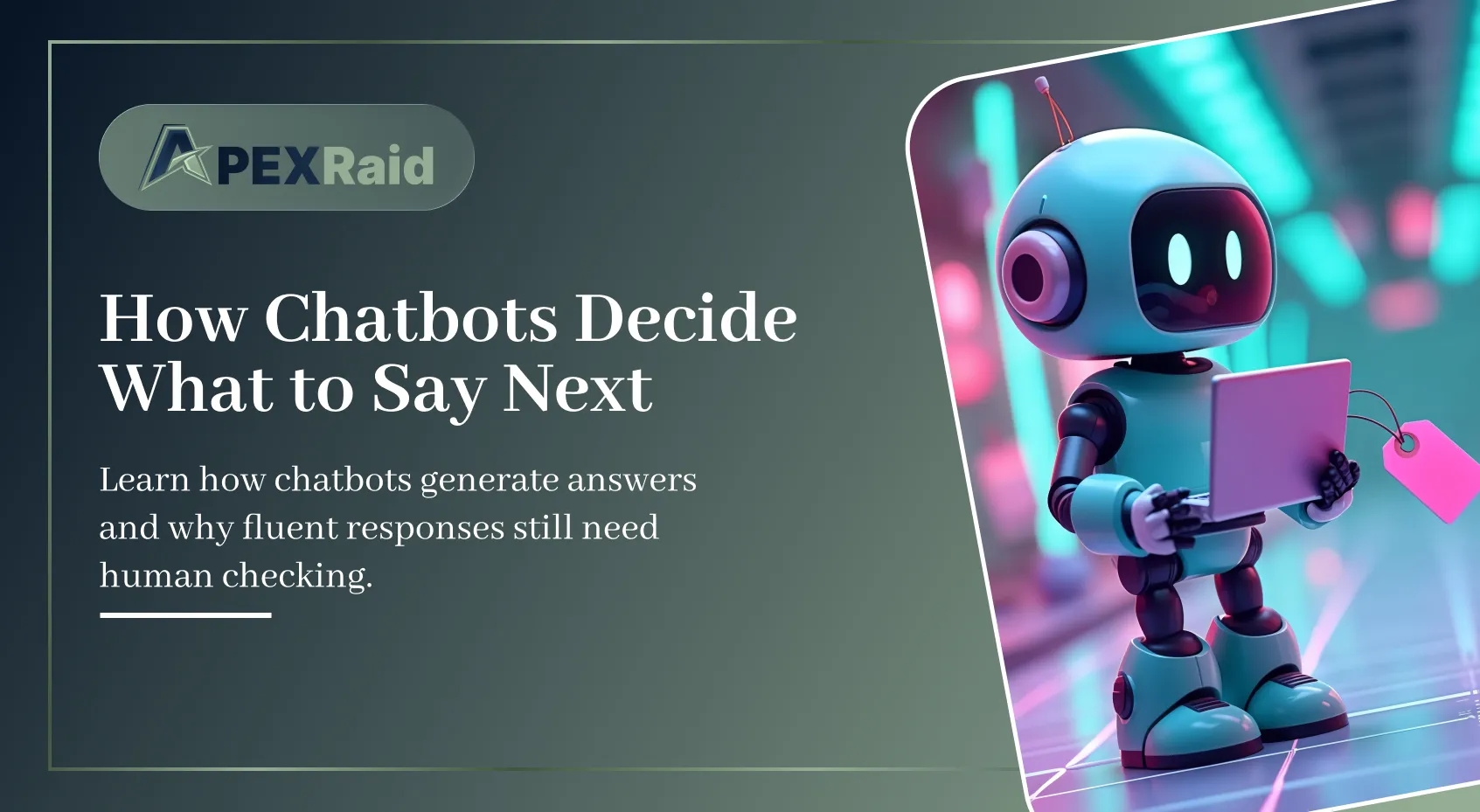
Chatbots feel smart because they answer quickly and in full sentences. That can make it seem like they are thinking through your question the way a person would. In reality, they are doing something different: they are predicting what text should come next based on patterns they learned earlier. This is the fundamental insight that explains both the remarkable capabilities and the significant limitations of modern AI chatbots.
That difference is the key to understanding how these tools work and why they sometimes sound confident even when they are wrong. Once you see the mechanism clearly, a lot of chatbot behavior starts to make more sense. As research on large language models has shown, these systems are fundamentally statistical pattern matchers, not reasoning engines — and understanding this distinction is essential for using them effectively.
Turning words into numbers
Before a chatbot can respond, it has to convert your words into a form a computer can work with. The text is broken into smaller pieces, often called tokens. A token might be a whole word, part of a word, or even a single character, depending on the tokenizer the model uses. For example, in many tokenizers, the word 'unbelievable' might be split into 'un', 'believ', and 'able' — three tokens rather than one long word. This allows the model to handle words it has not seen before by combining familiar subword units.
Those tokens are then turned into numbers through a process called embedding. Each token is assigned a numerical vector — essentially a long list of numbers — that represents its meaning in a high-dimensional mathematical space. Similar words have similar vectors: 'dog' and 'cat' are mathematically closer to each other than 'dog' and 'car' are. Once that happens, the model can compare patterns and estimate what the next likely word or phrase should be. Research on word embeddings has shown that these mathematical representations capture surprisingly rich semantic relationships, including analogies like 'king is to queen as man is to woman.'
You can think of it as a very advanced autocomplete system. It is not looking up a perfect answer from memory. It is choosing the next piece of language that best fits the pattern of the conversation. That might sound small, but it is the whole trick. Once language becomes a sequence of numbers, the machine can start doing its job: looking for the most likely next step. That is why the model can continue a sentence so naturally even when it is not actually 'thinking' in the human sense.
The Transformer Architecture: How Attention Works
The breakthrough that made modern chatbots possible was the introduction of the Transformer architecture, first described in the 2017 paper 'Attention Is All You Need' by Vaswani and colleagues at Google. Before Transformers, language models struggled with long-range dependencies — they had difficulty tracking information across more than a few sentences. The Transformer solved this through a mechanism called self-attention.
Self-attention allows the model to weigh the importance of every token in the input against every other token. When processing the sentence 'The dog that was barking at the mail carrier chased the cat,' the model can establish a strong connection between 'dog' and 'chased' even though they are separated by several words. It does this by calculating attention scores — mathematical weights that determine how much each token should influence the representation of every other token. The result is a model that can understand context and relationships across long passages of text.
The Transformer also introduced positional encoding, a way to give the model information about the order of words. Since the attention mechanism treats all tokens simultaneously (rather than sequentially), the model needs a way to know that 'cat chased dog' is different from 'dog chased cat.' Positional encodings provide this information by adding a unique signal to each token based on its position in the sequence.
Modern chatbots are built on this architecture, scaled up to billions or even trillions of parameters. Research on scaling laws has found that increasing the size of the model, the amount of training data, and the compute used for training leads to predictable improvements in performance — which is why companies have been racing to build ever-larger models.
Why the answers sound so smooth
Chatbots are trained on large amounts of text — often hundreds of billions of words from books, websites, articles, and other sources. During training, the model is shown millions of examples of text and asked to predict the next token in each sequence. Over time, it learns the statistical patterns of language: how sentences are typically structured, how ideas are connected, and what makes a response sound natural and fluent.
The result is a model that is exceptionally good at producing language that reads like it was written by a person. It knows how explanations usually flow, how people ask follow-up questions, and how an answer should be structured. That is why it can produce something that reads like a polished human response almost instantly. The GPT-4 technical report describes how the model was trained on a diverse dataset and fine-tuned through reinforcement learning from human feedback (RLHF) to produce responses that humans find helpful, accurate, and safe.
But sounding polished is not the same as being correct. A chatbot can write clearly and still miss the point. It can explain something beautifully and still be a little wrong in the details. That is part of why these tools are useful for drafts, summaries, and explanations, but not something you should trust blindly when precision matters. The smoothness is a feature, but it can also hide uncertainty.
Training Data and the Limits of Knowledge
A chatbot's knowledge is entirely defined by its training data. It does not have direct access to the internet, a database of facts, or any external source of truth unless specifically designed to include such access (through a feature called 'retrieval-augmented generation'). Everything the model 'knows' is encoded in the patterns it learned during training.
This has several important implications. First, the model has a knowledge cutoff — it does not know anything that happened after its training data was collected. For example, a model trained in early 2023 does not know about events from late 2023 or 2024. Second, the model has no way to verify facts. It can only reproduce patterns it has seen. If the training data contains errors, the model will reproduce those errors. If the training data is biased, the model will reflect those biases. Research on bias in language models has documented systematic biases related to gender, race, and other demographic categories, reflecting the biases present in the training data.
Third, the model has no understanding of truth or falsehood in the human sense. It does not 'know' that some statements are true and others are false — it only knows which patterns are more or less likely. This is why models can confidently assert false statements: they are following the pattern of confidently asserting statements, regardless of whether those statements are true.
Fourth, the model's knowledge is distributed — it does not have a single 'fact database' that it queries. Instead, factual information is distributed across millions of parameters, which makes it difficult to determine exactly what the model knows or to update its knowledge easily. This is why models can be 'forgetful' or inconsistent: they may have learned a fact but fail to retrieve it in a particular context.
The Challenge of Hallucination
When a chatbot does not have enough good information, it may fill the gap with something that sounds reasonable. This is called hallucination — the generation of content that is coherent and fluent but factually incorrect or entirely fabricated. Hallucination is one of the most significant challenges facing AI chatbots, and it has been the subject of extensive research. A 2023 review published in the journal AI and Society identified that hallucination rates vary widely depending on the task, ranging from 5% for simple factual recall to over 50% for complex reasoning tasks.
There are several reasons hallucinations occur. First, the model is optimised to produce fluent, plausible text, not necessarily accurate text. If the training data contains conflicting information, the model may produce a synthesis that is fluent but not accurate. Second, the model has no internal mechanism for knowing when it is uncertain. Unlike a person, who can say 'I don't know,' the model will produce a response regardless of whether it has the information. Third, the model is incentivised to be helpful, which means it tries to answer questions even when it lacks the necessary knowledge — and sometimes this leads to making things up.
This is why you should be careful with topics that need exact facts, current details, or expert judgment. If the topic is narrow, recent, or very specific, the model may not have enough support to stay accurate. Sometimes the answer is close enough to seem fine at first glance. That is why checking matters. A wrong answer does not always look obviously wrong. It often looks close enough that a busy person would not notice the problem unless they checked a second source.
Why the same question can get different replies
You may notice that if you ask the same question more than once, the answer changes a little. That happens because the model does not always choose the exact same next word every time. It can be tuned to be more predictable or a bit more varied through a setting called temperature. A low temperature (e.g., 0.1) makes the model almost always choose the most likely next token, producing very consistent outputs. A high temperature (e.g., 0.9) makes the model more creative and varied, producing different responses each time.
That variation helps the tool feel less robotic, but it also means the answer is not fixed in stone. It is generated fresh each time. Two replies can be broadly similar and still differ in wording, emphasis, or examples. That is one reason people sometimes get confused when they keep asking the same question. The model is not being inconsistent on purpose. It is just generating new text in real time, one token at a time.
Research on temperature and creativity has found that higher temperature settings produce more diverse and sometimes more interesting responses, but also more errors. Lower temperature settings produce more predictable and reliable responses, but can feel repetitive or rigid. Users can adjust this setting in many chatbot interfaces to suit their needs.
Guardrails and Safety Measures
Because chatbots can produce harmful, biased, or inappropriate content, developers have implemented various guardrails and safety measures. These typically include several layers of moderation:
- Pre-training filtering: The training data is filtered to remove explicit content, hate speech, and other harmful material.
- Fine-tuning with RLHF: The model is trained to prefer responses that human evaluators have rated as helpful, accurate, and safe. This helps the model learn what kinds of responses are appropriate.
- Instruction following: The model is trained to follow instructions, including explicit instructions not to produce harmful content.
- Prompt filtering: Some systems filter the user's input to block harmful or inappropriate queries.
- Output filtering: Some systems filter the model's output before displaying it to the user, blocking or rewriting responses that violate safety policies.
Despite these measures, research on AI safety has shown that determined users can often bypass these guardrails through techniques like prompt engineering, adversarial inputs, and role-playing scenarios. This is an ongoing challenge for the field.
It is also worth noting that guardrails can sometimes make the model less useful. Overly aggressive filtering can block legitimate queries, especially about sensitive but important topics like mental health, politics, or social issues. Finding the right balance between safety and utility is an ongoing challenge for AI developers.
How to use chatbots well
The best way to use a chatbot is to treat it like a fast drafting partner. It can help you brainstorm, summarize, organize ideas, or explain something in simpler words. But if the answer matters, you should still verify it with a trusted source. This is especially important for factual questions, current events, medical information, legal advice, and any topic where being wrong could have consequences.
A good prompt helps too. The more context you give, the better chance the model has of staying on target. If you want a practical answer, ask for one. If you want a short answer, say so. If you want the model to stick to a specific source, make that clear. Research on prompt engineering has identified several effective strategies: being specific about your request, providing examples of the kind of output you want, asking the model to think step by step, and asking it to show its reasoning.
It can also help to ask the model to show uncertainty instead of hiding it. When a chatbot admits that something may be approximate, that is a useful signal. It means you have a better sense of where the answer is solid and where it is guessing. You can even ask the model to provide a confidence rating or to identify sources of uncertainty.
Another useful strategy is chain-of-thought prompting — asking the model to explain its reasoning step by step. This can make it easier to identify errors in the model's thinking and to verify the logic of its response. For complex problems, asking the model to break its reasoning into steps often produces more accurate and more trustworthy answers.
Finally, consider triangulating by asking the same question in different ways or using different models. If multiple chatbots give similar answers, that increases confidence in the answer. If they disagree, that is a signal to investigate further.
What users should remember
Chatbots are not magic and they are not human. They are pattern machines that do a very good job of sounding like they understand. That is useful, but it is also why people can trust them a little too quickly. Research on AI anthropomorphism has found that people consistently attribute human-like understanding to AI systems, even when they know how the systems work. This tendency can lead to overreliance and misplaced trust.
The safest habit is simple: use them for speed and structure, then check them for truth. If you keep that habit, the tool stays helpful without becoming misleading. It is also worth remembering that chatbots are not responsible for their outputs — you are. If you rely on a chatbot's answer and it turns out to be wrong, you bear the consequences. This is why verification is not just a good practice; it is a necessary one.
For students, researchers, and professionals, this means treating chatbots as assistants, not authorities. They can accelerate your work, but they cannot replace your judgment. The most effective AI users are those who combine the speed and fluency of the machine with their own critical thinking and domain expertise.
Key takeaway
Chatbots do not think like people. They predict the most likely next words based on patterns in their training data. That makes them useful, but it also means their answers should always be checked when accuracy matters. Understanding the mechanism — tokenization, embeddings, attention, and the statistics of language — helps you use these tools more wisely and avoid the common mistake of treating a fluent answer as a true one.
If you remember that one thing, you will already use them more wisely than many people do. The technology is powerful, but it is not magic — and the best way to harness its power is to understand what it is actually doing.