
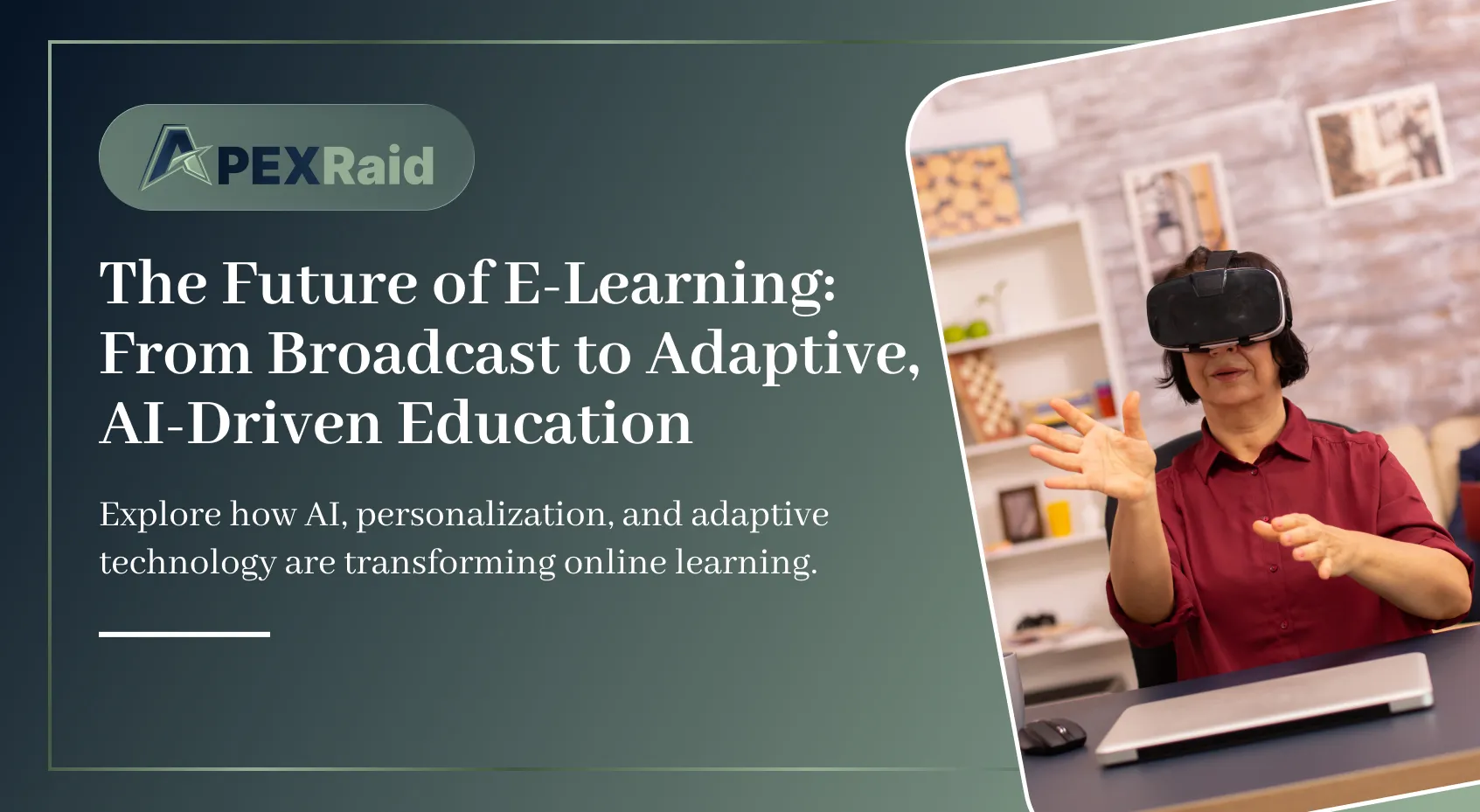
For the first two decades of the internet, the concept of 'e-learning' was fundamentally limited by its architecture. It consisted almost entirely of taking traditional, physical classroom materials (textbooks and hour-long lectures) and simply digitizing them as PDFs and static video files. This was not a revolution in education; it was merely a change in distribution. However, the modern intersection of artificial intelligence, high-speed connectivity, and cognitive science is actively destroying the static 'broadcast' model of education. The future of e-learning is not about watching a video on a screen; it is about interacting with highly adaptive, personalized digital environments that dynamically restructure themselves around the neurological reality of the individual learner. Research on the evolution of e-learning has documented this transition from content delivery to adaptive learning, identifying the shift as one of the most significant pedagogical developments of the 21st century.
This guide provides a comprehensive, evidence-based analysis of the future of e-learning, examining the limitations of traditional models, the rise of adaptive learning, the role of cognitive science, and the technologies that will define the next generation of digital education.
The Failure of the Broadcast Model
The traditional educational model, whether delivered in a physical university lecture hall or via a static online video, is inherently flawed. It relies on the Broadcast Model — a single instructor delivering a standardized, uniform stream of information to a massive, heterogeneous group of students simultaneously. Research on one-size-fits-all education has shown that this model fails to accommodate the individual differences in learning speed, style, and prior knowledge that exist in any classroom.
This model completely ignores the reality of human cognitive variation. In a class of 100 students, some will grasp a concept in two minutes, while others require twenty. In a static broadcast model, the fast learners are forced into extreme boredom, while the slower learners are left behind, accumulating massive gaps in their foundational knowledge that guarantee future failure. The early iterations of Massive Open Online Courses (MOOCs) attempted to scale this flawed model globally, resulting in abysmal completion rates (often hovering below 10%), proving that simply placing a camera in front of a lecturer does not constitute effective digital education. A comprehensive study of MOOC completion rates found that average completion rates across thousands of courses were only 5-15%, with the lowest rates in STEM subjects.
The broadcast model also assumes that all students enter the learning environment with the same foundational knowledge — an assumption that is almost never true. Students arrive with vastly different levels of prior knowledge, and the broadcast model has no mechanism for addressing these differences. The result is a system that serves the mythical 'average' student while failing the majority of learners at both ends of the spectrum.
The Rise of Adaptive Learning Algorithms
The true revolution in e-learning is the implementation of Adaptive Learning platforms powered by Artificial Intelligence (AI). Instead of a static syllabus, an adaptive platform acts as a relentless, highly personalized digital tutor. Research on adaptive learning systems has found that they can significantly improve learning outcomes, particularly for students who struggle with traditional instruction.
When a student interacts with an adaptive platform, the software does not simply grade their answers as right or wrong. The algorithm aggressively analyzes thousands of micro-data points in real-time: how long the student hesitated before answering, the specific type of distractor answer they chose, the sequence in which they accessed the material, and the specific time of day they are most cognitively active. Research on learning analytics has shown that these micro-patterns are highly predictive of learning outcomes and can be used to provide targeted interventions.
Using this vast data set, the AI continuously, dynamically alters the curriculum for that specific individual. If the algorithm detects that the student fundamentally misunderstands a core concept (e.g., calculating fractions), it will immediately halt the progression of the course. It will algorithmically generate a series of remedial exercises, attacking the specific cognitive block from multiple different pedagogical angles until mastery is statistically proven. Conversely, if a student instantly masters a topic, the software will automatically accelerate them past the redundant material. This ensures that the student is permanently operating at the absolute edge of their competence — the Zone of Proximal Development — maximizing engagement and eliminating the inefficiencies of the broadcast model. Vygotsky's concept of the Zone of Proximal Development remains central to modern adaptive learning design, with AI systems continuously calibrating content to maintain optimal challenge.
Adaptive learning platforms also address the problem of knowledge decay. By using spaced repetition algorithms, they ensure that students revisit concepts at optimal intervals for long-term retention. Research on spaced repetition has shown that it can improve long-term retention by up to 50% compared to massed practice, making it one of the most effective learning techniques available.
The Neuroscience of Learning
The future of e-learning is also heavily dictated by the findings of cognitive psychology and neuroscience, specifically regarding Cognitive Load Theory and Neuroplasticity. Cognitive Load Theory, developed by John Sweller in the 1980s, established that the human working memory is severely limited in its capacity to process novel information. Forcing a student to consume a dense, uninterrupted 60-minute video lecture violently overwhelms this capacity, resulting in catastrophic knowledge retention failure.
Modern e-learning architecture is pivoting aggressively toward Microlearning. Instead of massive, monolithic lectures, educational content is atomized into highly focused, single-objective bursts of learning, typically lasting no longer than 3 to 7 minutes. A student might watch a 4-minute video explaining a single concept, immediately followed by a short, interactive quiz that forces active recall, and then a practical, simulated application of the concept. Research on microlearning effectiveness has found that it produces significantly better learning outcomes than traditional lecture-based instruction, with effect sizes ranging from 0.4 to 0.8 standard deviations.
This atomized structure respects the biological limits of the human brain. It prevents cognitive overload, allows for highly specific, targeted learning interventions, and crucially, fits seamlessly into the fractured, high-speed reality of modern adult life, allowing professionals to consume educational content during a commute or between meetings rather than dedicating massive, continuous blocks of time. Adoption research on microlearning has found that it is particularly effective for workplace learning, where employees often have limited time for professional development.
The neuroscience of learning also highlights the importance of active recall — the process of retrieving information from memory rather than passively reviewing it. Research on the testing effect has found that practice testing is one of the most effective learning strategies, improving retention by up to 50% compared to passive review. Modern e-learning platforms increasingly incorporate frequent, low-stakes testing to leverage this effect.
Gamification and the Economics of Engagement
The most significant hurdle in e-learning is not the delivery of information; it is the maintenance of human motivation. Without the physical presence, social pressure, and immediate accountability of a traditional classroom, online learners frequently abandon their courses. To combat this, e-learning platforms are heavily integrating Gamification — the application of video game mechanics to non-game environments. This involves implementing highly engineered systems of rapid feedback, variable rewards, progression trees, and social leaderboards. Research on gamification in education has found that it can increase engagement and motivation, though the effects are highly dependent on implementation quality.
However, elite gamification is not simply adding superficial 'badges' or 'points' to a boring quiz. It is the deep structural integration of interactive, high-stakes simulations. Medical students are not just reading about surgical procedures; they are executing them in highly realistic Virtual Reality (VR) environments where mistakes have simulated, severe consequences. Corporate employees are not watching sexual harassment compliance videos; they are navigating complex, branching dialogue trees with AI-driven avatars to practice conflict resolution in real-time. Research on simulation-based learning has found that it produces significantly better skill transfer than traditional instruction, with effect sizes exceeding 0.8 in many studies.
The engagement challenge is compounded by the attention economy. E-learning platforms compete with social media, streaming services, and countless other digital distractions for users' attention. Research on attention and learning has found that the average human attention span has decreased significantly in the digital age, making engagement design more critical than ever.
Virtual Reality and Immersive Learning
One of the most exciting developments in e-learning is the integration of Virtual Reality (VR) and Augmented Reality (AR). These technologies offer the potential for immersive learning experiences that were previously impossible in any format. Research on VR in education has found that immersive learning experiences can improve knowledge retention by up to 80% compared to traditional instruction, with particularly strong effects in fields that require spatial understanding, such as anatomy, engineering, and architecture.
VR allows students to explore historical sites, conduct virtual experiments, and practice complex procedures in a risk-free environment. Research on immersive learning effectiveness has found that it is particularly effective for developing procedural skills and for learning that requires three-dimensional understanding.
AR overlays digital information onto the physical world, providing contextual learning experiences. Research on AR in education has found that it can improve engagement and understanding, particularly in fields like science and engineering where visualisation is key.
The cost of VR and AR technology has decreased significantly in recent years, making these tools increasingly accessible for educational institutions and individual learners. As the technology continues to improve, immersive learning is likely to become a standard component of e-learning.
Equity and Access in the Digital Age
While the potential of AI-driven e-learning is enormous, it also raises significant equity concerns. Research on the digital divide has found that access to technology and high-speed internet remains highly unequal, with significant disparities based on geography, income, and race. Students in rural areas, low-income communities, and developing countries often lack the infrastructure needed to benefit from advanced e-learning platforms.
Furthermore, the effectiveness of AI-driven platforms depends on the quality of the underlying algorithms. Research on algorithmic bias in education has found that adaptive learning systems can perpetuate existing educational inequalities if they are trained on biased data or designed without consideration of diverse learning needs.
Addressing these equity concerns requires intentional policy and investment. Research on education equity and technology has identified several strategies: investment in broadband infrastructure, development of low-cost educational technologies, and the design of adaptive systems that are explicitly designed to reduce rather than reinforce educational disparities.
Practical Implications for Learners and Educators
The shift to AI-driven e-learning has significant practical implications for both learners and educators:
- For learners: The future of e-learning offers unprecedented opportunities for personalized, flexible education. Learners can expect to have access to adaptive platforms that adjust to their individual needs, VR experiences that provide immersive learning, and AI tutors that offer instant feedback and support. However, learners must also develop skills in self-directed learning and digital literacy to make the most of these tools.
- For educators: The role of the educator will shift from content delivery to mentoring and facilitation. Educators will spend less time preparing and delivering lectures and more time guiding students through personalized learning paths, interpreting learning analytics, and providing high-touch support where it is most needed. Research on the future of educator roles has found that the most effective approaches combine AI support with human teaching.
- For institutions: Educational institutions will need to invest in the infrastructure and expertise required to implement AI-driven learning platforms. This includes not only technology but also training for educators and ongoing evaluation of learning outcomes.
- For policymakers: Policymakers will need to address equity concerns by investing in infrastructure and ensuring that the benefits of AI-driven education are available to all learners.
The Democratization of Education
The future of e-learning represents the total democratization of elite education. By uncoupling the quality of instruction from the physical limitations of a classroom, and utilizing artificial intelligence to provide the equivalent of an incredibly patient, highly optimized private tutor for a fraction of the cost, digital education is rapidly transitioning from a poor substitute for the physical classroom into an objectively superior pedagogical tool. Research on the democratisation of education has found that AI-driven platforms can provide high-quality instruction to learners who would otherwise have limited access to educational resources.
The implications are profound. A student in a rural village can now access the same quality of instruction as a student at an elite university. A working professional can upskill at their own pace, on their own schedule. A lifelong learner can explore new subjects with the support of an AI tutor that never gets tired, never gets impatient, and is always available.
However, the democratisation of education is not automatic. It requires intentional investment, thoughtful design, and a commitment to equity. The technology exists; the challenge is ensuring that it is accessible to all.
Conclusion
The future of e-learning is not about technology for its own sake. It is about fundamentally reimagining what education can be. It is about moving from a broadcast model that serves the mythical 'average' student to an adaptive model that serves every individual learner. It is about using AI not to replace teachers but to empower them, freeing them to focus on the human dimensions of education — motivation, mentoring, and community building.
As research on the future of e-learning consistently emphasises, the most effective educational systems will be those that combine the scalability and personalisation of AI with the empathy and expertise of human educators. The future is not AI versus humans; it is AI plus humans, working together to create learning experiences that are more effective, more engaging, and more equitable than anything that has come before.