
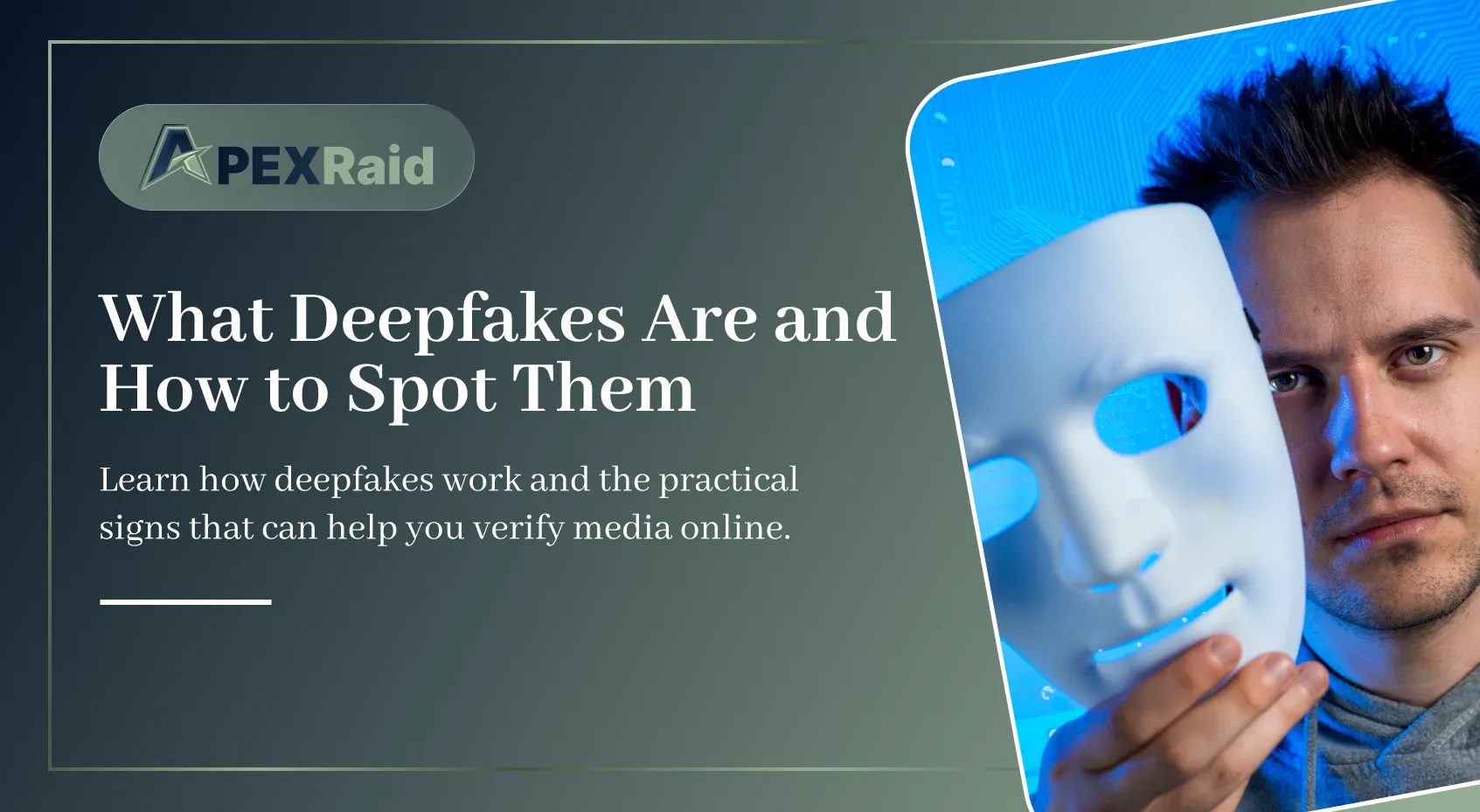
Deepfakes are fake images, audio clips, or videos made with AI so that someone appears to say or do something they never actually did. The term itself combines 'deep learning' and 'fake' to describe content transformed by AI that impersonates human appearance, voice, and behaviour across images, videos, and audio[reference:0]. Some are playful, some are experimental, and some are made to deceive. That mix is what makes them such a serious modern trust issue.
At a glance, a deepfake can look like normal media. It may show a familiar face, a believable setting, and a voice that sounds close enough to be convincing. The problem is not only that the content is fake. The problem is that it can be fake in a way that feels ordinary until you look more closely.
While the concept of media manipulation is not new, the sophistication and accessibility of AI-driven deepfakes present significant threats of misinformation and societal manipulation[reference:1]. Deepfakes are driven by developments in generative AI and seriously jeopardise public trust, cybersecurity, and the veracity of information[reference:2].
Why Deepfakes Work So Well
Modern AI tools can learn facial patterns, voice qualities, and movement styles from real examples. When those patterns are blended into new media, the result can look surprisingly convincing. A face may move naturally enough, a voice may sound close enough, and the overall clip may be good enough to pass a quick glance.
That is why deepfakes often succeed in the exact situation where people are least prepared to check: when they are scrolling fast, reacting emotionally, or sharing something that seems to confirm a feeling they already had. The emotional angle matters. People tend to move faster when a clip makes them angry, scared, amused, or certain. That speed is part of the trick. A fake does not always need to be perfect. It just needs to get shared before anyone slows down.
A 2026 study published in Communications Psychology found that most participants relied on the content of a deepfake video even when they had been explicitly warned beforehand that it was fake[reference:3]. This result was observed even among participants who indicated that they believed the warning and knew the video to be fake[reference:4]. The findings suggest that transparency is insufficient to entirely negate the influence of deepfake videos, which has significant implications for legislators, policymakers, and regulators of online content[reference:5].
How the Fakes Are Changing
Early deepfakes were often clumsy. The eyes looked strange, the mouth lagged, or the lighting made the edit obvious. That is less true now. The tools have improved a lot, and the telltale mistakes are often smaller and harder to catch. A fake may look fine on a phone screen and still be synthetic.
That means older advice is no longer enough by itself. It is not always about spotting a weird blink or a bad jawline. Sometimes the more useful clue is the context around the clip, not the clip alone. Generative Adversarial Networks (GANs), introduced in 2014, significantly elevated the quality of deepfake media, making it increasingly challenging to differentiate between authentic and fabricated content[reference:6]. Variational autoencoders (VAEs) have also become useful tools in the creation of deepfakes[reference:7].
The Scale of the Threat: Deepfakes by the Numbers
The growth of deepfake media has been exponential. In 2023, an estimated 500,000 deepfakes were circulating. By 2025, that number had surged to approximately 8 million[reference:8][reference:9][reference:10]. Deepfake incidents in the first half of 2025 already exceeded the total from the entire prior year by 171%[reference:11][reference:12]. The implications extend far beyond individual deception — deepfakes are now a systemic risk to financial markets, democratic elections, public health, and personal safety[reference:13].
Financial Fraud: Deepfake-enabled fraud is growing at an alarming rate. Financial losses exceeded $200 million in Q1 2025 alone[reference:14]. In the United States, deepfake-related losses reached $1.1 billion in 2025, tripling from $360 million the prior year, with deepfake-enabled vishing attacks surging over 1,600% between Q4 2024 and Q1 2025[reference:15]. In one widely reported 2024 incident, criminals used deepfake video to impersonate senior executives at British engineering firm Arup, convincing staff to transfer $25 million to fraudulent accounts[reference:16]. Deloitte projects that deepfake-enabled fraud losses in the US alone could reach $40 billion by 2027[reference:17]. Just three seconds of audio is now sufficient to clone a voice with an 85% match to the original speaker[reference:18].
Non-Consensual Intimate Imagery: The most common use of deepfake technology by volume remains the creation of non-consensual sexually explicit content. In Q2 2025, 84% of deepfake attempts targeted women[reference:19]. South Korea reported approximately 297 deepfake sex crime cases in just seven months of 2024, nearly double the figure from 2021[reference:20]. European Commission data indicates that pornographic material accounts for about 98% of deepfakes[reference:21]. AI-generated sexual images of Taylor Swift reached 47 million views before removal[reference:22].
Political Manipulation: The weaponization of deepfakes in elections has accelerated dramatically, with 38 countries experiencing election-related deepfake incidents since 2021, affecting a population of 3.8 billion people[reference:23]. In the January 2024 New Hampshire primary, a deepfake Biden robocall urged Democrats not to vote, resulting in a $6 million FCC fine[reference:24].
How Humans and AI Perform at Detecting Deepfakes
Detection accuracy varies widely, with some studies showing humans outperforming AI models and others indicating the opposite[reference:25]. Detection performance is influenced by person-level factors (e.g., cognitive ability, analytical thinking) and stimuli-level factors (e.g., quality of deepfake, familiarity with the subject)[reference:26].
Overall human deepfake detection accuracy from a systematic review of 67 studies was 55.54% — barely above chance[reference:27]. A 2025 iProov study found that only 0.1% of human participants correctly identified all deepfakes and genuine media shown to them[reference:28]. However, performance improves with video content: a University of Florida study found that humans correctly identified real and fake videos about two-thirds of the time[reference:29]. Participants appeared to pick up on subtle inconsistencies in movement, facial expressions, and timing — cues that algorithms struggled to interpret[reference:30].
AI programs were up to 97% accurate at detecting pictures of deepfake faces, while human participants performed no better than chance[reference:31]. However, algorithms' performance declined sharply on deepfake videos, performing at chance levels[reference:32]. The findings suggest that for still images, automated detection tools may now outperform human judgment alone, but people still have an advantage when it comes to identifying deepfake videos[reference:33]. People's abilities and even mood made a difference: those who scored higher in analytical thinking and internet skills were better at detecting AI-generated videos, while participants who reported being in a better mood performed worse[reference:34]. This suggests that positive mood may reflect greater trust and reduced vigilance.
Interventions to improve people's deepfake detection have yielded mixed results[reference:35]. Humans and AI-based detection models focus on different aspects when detecting, suggesting a potential for human–AI collaboration[reference:36]. The complex interplay of factors influencing human deepfake detection highlights the need for further research to develop effective strategies[reference:37].
Why Source Matters More Than Ever
Even when a video looks realistic, the source can tell you whether it deserves trust. Was it posted by an account with a track record? Can you find the same clip elsewhere? Has a reliable outlet or official account confirmed it? Those questions usually matter more than whether the image looks sharp.
If a claim is important, do not stop at the first version you see. Look for fuller context. A clipped video can hide the moment before or after the key event, and that missing part can completely change the meaning. This is especially important when a clip is attached to a political claim, a celebrity rumour, or a breaking story. Those are the situations where people are most likely to share before checking.
Deepfakes are hard to beat because attackers can mix authentic and synthetic material, tailor content to a single target, and spread it at speed. Even strong detectors can struggle once content is compressed, re-uploaded, or subtly edited again, and false positives can wrongly implicate real people[reference:38].
Signs That Something May Be Off
There is no single foolproof test, but a few patterns are worth watching. The mouth may not quite match the audio. The face may move a little too smoothly. Hair, teeth, jewellery, or shadows may shift strangely. The background may warp. The edge of the face may look soft in a way that does not fit the rest of the image.
Another clue is the source. If a shocking clip appears with no clear origin, or only from accounts that are trying to stir up anger, that is a reason to slow down. Content that spreads fastest is not always content that is true.
It also helps to notice how the clip makes you feel. If it is designed to trigger a fast reaction, that does not prove it is fake, but it does mean you should be careful before sharing it. Emotional pressure is one of the easiest ways for misinformation to spread.
How to Verify Before Sharing
If the content is an image, a reverse image search can help. If it is a video, search for the full context rather than only the short version being pushed on social media. Check whether the clip appears on trusted news sites or official pages. If nobody reliable has mentioned it, that is a warning sign.
When possible, compare multiple copies of the same media. Sometimes a fake only becomes obvious when you notice that different versions have different captions, timestamps, or cropped sections. A little verification can go a long way.
The point is not to become suspicious of everything. The point is to pause long enough to see whether the media is real before you help spread it.
Why Deepfakes Matter Beyond Gossip
Deepfakes are not just about celebrity jokes or entertainment edits. They can be used for scams, political manipulation, harassment, and fraud. A fake voice can pretend to be a family member in trouble. A fake video can damage someone's reputation. A fake image can be used to support a false story that spreads fast.
That is why this topic matters for ordinary users. You do not need to be a journalist or a tech specialist to run into a deepfake. You just need to be online.
Legal and Policy Responses
Governments around the world are responding to the deepfake threat with new legislation and regulations. In the United States, New Jersey passed legislation in April 2025 establishing civil and criminal penalties for the production and dissemination of deceptive audio or visual media[reference:39]. Italy introduced a new criminal offence for the dissemination of AI-generated deepfakes under Article 612-quater of the Italian Criminal Code[reference:40].
In India, the Ministry of Electronics and Information Technology released draft amendments to the Information Technology Rules in October 2025, addressing the threats from the misuse of artificially generated content, including deepfakes, misinformation and other unlawful content[reference:41][reference:42]. China issued new regulations on 'Measures for Identifying Artificial Intelligence-Generated Synthetic Content' in September 2025, requiring online platforms hosting or disseminating synthetically generated information to have clear labels to identify synthetic content[reference:43].
Social media platforms are also responding. Google and Meta already have labelling or disclosure policies for AI, deepfake or synthetic content[reference:44]. In November 2025, Facebook and Instagram began requiring users to label AI-generated or modified content in accordance with new government regulations[reference:45]. Meta has stated that any deepfake content that violates its policies will be removed, or rated 'altered' and then ranked down in its feed to limit its distribution[reference:46].
However, tech companies face challenges: Meta, for example, has struggled to find ways to deal with deepfake videos that have the potential to deceive and manipulate users on a massive scale[reference:47]. The UK government is developing a deepfake detection evaluation framework to benchmark tools against real-world threats[reference:48].
This regulatory landscape is rapidly evolving, but the fundamental challenge remains: detection is only part of the solution[reference:49]. As UK Tech Secretary Liz Kendall noted, 'Deepfakes are being weaponised by criminals to defraud the public, exploit women and girls, and undermine trust in what we see and hear'[reference:50].
What Ordinary Users Can Do
You do not need to be a cybersecurity expert to protect yourself and others from deepfakes. Here are practical habits that help:
- Slow down: If a clip feels too perfect, slow down. If the claim is explosive but the source is weak, slow down. If the post seems designed to make you react first and think later, slow down. Those moments are exactly when fake media tends to travel the farthest.
- Check the source: Before sharing, ask: where did this come from? Is this a verified account? Has a reliable news outlet reported on it?
- Look for context: A clipped video can be misleading. Search for the full version or additional coverage.
- Use verification tools: Reverse image search can help identify whether an image has been used before in a different context. For audio or video, listen for unnatural pacing or inconsistencies.
- Trust your gut — but verify: If something feels off, it probably is. But don't stop there — verify before you share.
- Stay informed: Deepfake technology is evolving rapidly. Staying up to date on new detection methods and common tactics can help you stay ahead.
It can also help to ask one simple question: would this still make sense if I saw it from a source I trust? That question does not catch every fake, but it often exposes the ones built on hype instead of evidence.
Key Takeaway
Deepfakes are synthetic media that can look surprisingly real, so source checking matters more than ever. The safest habit is to pause, verify, and share only when the content has been confirmed by reliable evidence.
As the University of Florida researchers noted, 'We don't necessarily need to be able to detect everything ourselves. But we do need to stay alert, question what we see and look for evidence to support it'[reference:51]. In a world where fake media keeps getting better — and where 8 million deepfakes were shared in 2025 alone[reference:52]— careful checking is part of everyday digital life.