
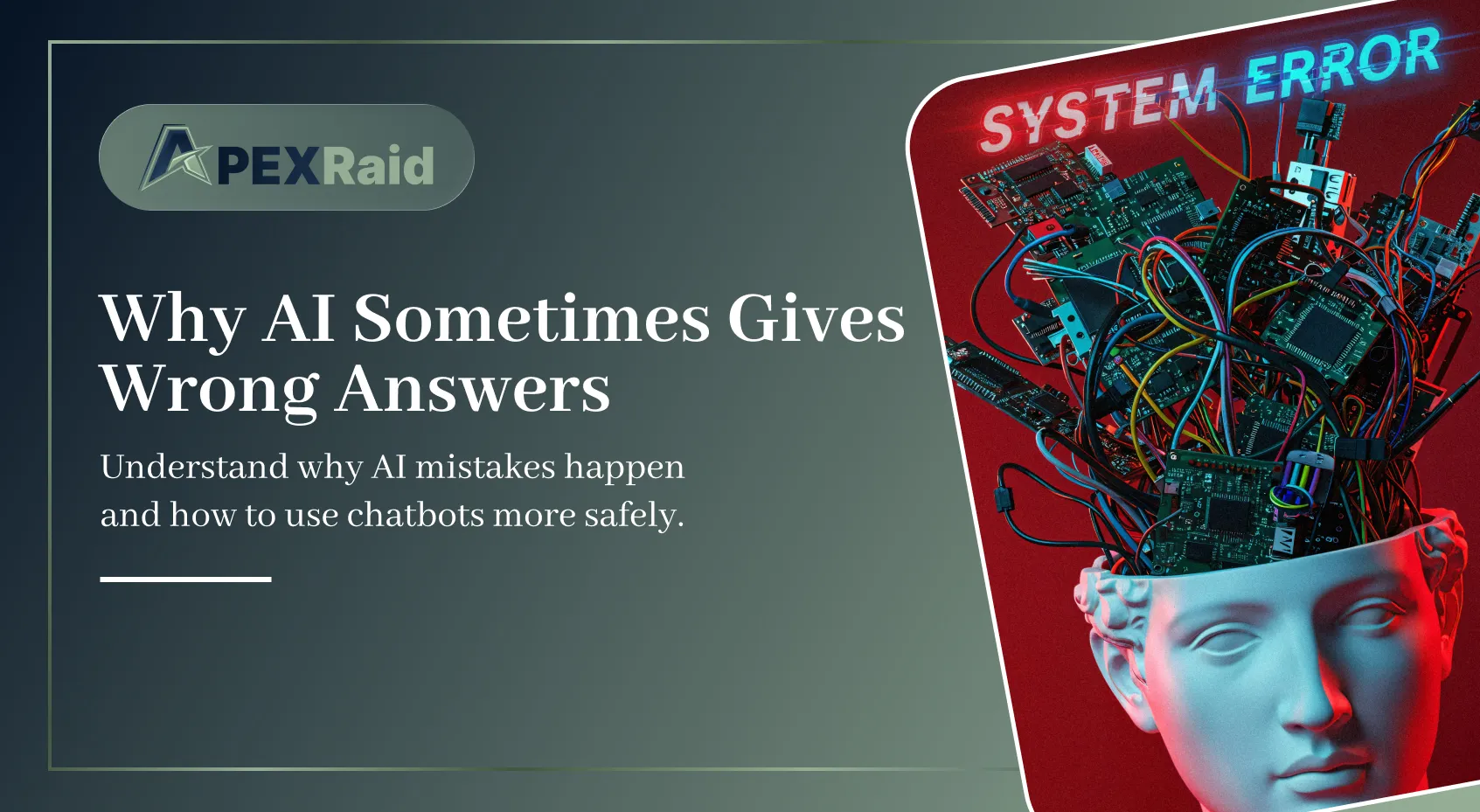
AI can be useful and still be wrong. That is one of the first things people need to understand if they plan to use it well. A chatbot does not verify facts the way a careful human researcher would. It usually tries to generate the most likely helpful answer based on patterns it has seen before, which means it can sound polished even when the content needs a second look. This phenomenon is known in the research literature as hallucination — a term that has become central to understanding the limitations of large language models.
That polished tone is part of why people trust AI too quickly. The sentence may read smoothly, the structure may look organised, and the wording may sound confident. But confidence is not the same thing as accuracy. That gap is where a lot of mistakes begin.
This guide provides a comprehensive, evidence-based examination of why AI sometimes gives wrong answers — exploring the mechanisms of hallucination, the psychology of user trust, the scale of the problem, and practical strategies for catching errors before they matter.
What Hallucination Means in AI
In the context of AI, hallucination refers to the generation of content that is plausible and fluent but factually incorrect, unsupported by the training data, or entirely fabricated. Research on hallucination in large language models has identified multiple types of hallucination, including factual inconsistency, logical contradiction, and fabrication of sources or citations.
Hallucinations are not random errors; they are a systematic feature of how these models work. Because language models are optimised for fluency and coherence — not for factual accuracy — they often prioritise generating a plausible-sounding answer over a correct one. A 2024 study on hallucination detection found that large language models reliably generate factually inconsistent content across a wide range of tasks and domains.
This behaviour is not the model being malicious or deceitful. It is the model doing exactly what it was trained to do: predict the most likely sequence of words based on patterns in its training data. When the training data lacks sufficient coverage of a topic, or when the model's probabilistic predictions lead it astray, the output can be confidently wrong.
Why Mistakes Happen: The Mechanisms
There are several interconnected reasons why AI models produce incorrect outputs. These mechanisms operate at different levels of the system:
Training data limitations: A model's knowledge is entirely defined by its training data. It does not have direct access to the internet or any external source of truth unless specifically designed to include such access. If the training data lacks coverage of a topic, contains errors, or is outdated, the model will reproduce those weaknesses. Research has shown that the composition and quality of training data significantly influence model performance, with issues such as duplicate data, dead websites, and machine-generated text affecting reliability.
Knowledge cutoff: Most AI models have a fixed knowledge cutoff date — they do not know anything that happened after their training data was collected. This means that for recent events, developments, or discoveries, the model is effectively blind. It may attempt to answer using outdated information or fabricate details to fill the gap.
Optimisation for fluency over accuracy: The training objective for language models is to predict the next word in a sequence. This optimises for linguistic fluency, not factual correctness. As a result, a model may produce a beautifully written response that is entirely incorrect. The hallucination literature makes clear that fluency and accuracy are distinct properties that are often in tension.
Vague or ambiguous prompts: When a prompt is ambiguous, under-specified, or open to multiple interpretations, the model must guess what the user wants. This increases the likelihood of producing an answer that sounds plausible but misses the mark.
The pressure to be helpful: AI systems are trained to be helpful and responsive. They are not trained to say 'I don't know' when they are uncertain. This means they will often produce an answer even when they lack the necessary information, increasing the risk of hallucination. Some modern systems include reinforcement learning from human feedback (RLHF), where the model is trained to generate responses that human evaluators prefer. This makes outputs more conversational and helpful, but also sometimes amplifies the model's tendency to guess rather than admit uncertainty.
Autoregressive generation: Language models generate text one token at a time, with each new token depending on the tokens that came before it. If the model makes an early error, that error can propagate through the entire response, leading to increasingly incorrect outputs.
What Bad Answers Often Look Like
AI errors are not always dramatic. Sometimes the answer is mostly correct but misses a detail that changes the meaning. Sometimes it mixes up two similar ideas. Sometimes it uses a source or citation that looks real until you check it. And sometimes it gives a broad answer that sounds useful but never really addresses the exact question you asked.
Another common problem is overconfidence. The model may say something with certainty when a careful person would say, 'I'm not sure.' That difference matters because users tend to trust firm language, even when the firm language is doing the work of a guess.
It also helps to remember that style can hide weakness. A response can be clean, organised, and easy to read while still missing the part that actually matters. Good formatting is not proof of good reasoning.
The Scale of the Problem: Empirical Findings
Research has quantified the scale of the hallucination problem across different models and tasks. A 2024 study on hallucination detection found that hallucination rates range from 3% to 20% depending on the model, the task, and the domain. The rates are higher for complex reasoning tasks, specialised domains, and questions requiring up-to-date information.
Research on AI hallucination rates has documented that even the most advanced language models produce factually incorrect statements at rates of 10-20% on complex questions, with the rate rising significantly on topics that are recent, niche, or controversial. This is because the model is optimised for linguistic fluency, not factual accuracy.
A comprehensive review of hallucination research identified that hallucination rates are influenced by the model architecture, the training data composition, the prompting strategy, and the difficulty of the task. Models with larger parameter counts generally hallucinate less on simple factual queries but may hallucinate more on complex reasoning tasks.
The 2024 study also found that no single detection method is universally effective across models and tasks. The most reliable approach is a combination of methods: confidence scoring, citation checking, and human verification. Research on hallucination detection has proposed various methods for identifying hallucinations, including uncertainty estimation, consistency checking, and fact-checking against external knowledge bases.
The Psychology of User Trust
One reason AI errors are so problematic is that users often trust the outputs too easily. A 2026 study published in Communications Psychology found that most participants relied on the content of a deepfake video even when they had been explicitly warned beforehand that it was fake. While this study focused on video, it highlights a broader tendency: people often trust fluent, confident outputs regardless of their accuracy.
Research on automation bias has shown that people tend to trust automated systems more than human judgment, even when the automated system is wrong. This is particularly concerning with AI, where the outputs are often more fluent and confident than human communication. A study on trust in AI systems found that users consistently overestimate the accuracy and reliability of AI-generated information, particularly when the responses are delivered with high confidence and in fluent, polished language.
This user tendency is amplified by the way AI is often marketed and presented. Companies may emphasise the capabilities of their AI while downplaying its limitations, creating unrealistic expectations. Users may approach AI with the mental model of a knowledgeable assistant rather than a statistical pattern generator.
The Dunning-Kruger effect applied to AI: the more fluent the output, the more likely people are to trust it, even when they have no reason to. Users with less knowledge of AI are particularly susceptible to overtrust, while those with more technical understanding tend to be more cautious.
How to Reduce the Risk
If you want better results, make the prompt more specific. Ask for the reason behind the answer. Ask for sources. Ask the model to list uncertainties. Ask it to separate what it knows from what it is estimating. Those small changes can expose weak spots before you rely on the reply.
It also helps to repeat the question in a slightly different way. If the answer changes a lot, that is a warning sign. If the model becomes vague or evasive when pushed for detail, that can actually be better than a confident guess.
For anything important, compare the answer with a trusted source before using it. That extra step is not overcautious. It is basic risk management. Research on AI hallucination recommends that users treat AI as a drafting tool, not a fact-checker, and always verify critical information using authoritative sources.
Where It Is Most Dangerous
AI mistakes matter most in health, legal, money, and news-related topics. In those areas, a wrong answer can lead to real harm. For casual brainstorming or wording help, the cost is lower. For decisions that affect your life or someone else's, verification is not optional.
That is why AI is often best used for drafting, summarising, or organising information rather than acting as the final authority. It can help you move faster, but it should not replace the final check. Think of it as a strong assistant with a blind spot. It can work quickly, but it still needs supervision when the stakes are high.
Research on hallucination has identified that the risks are highest in high-stakes domains such as healthcare, finance, and legal services, where inaccurate information can have serious consequences. In these domains, human oversight is essential.
A Practical Habit
A simple way to use AI more safely is to slow down whenever the answer feels too neat. If it is too clean, too certain, or too convenient, pause and ask whether the model is explaining something or just filling space. That pause is often enough to catch a problem before it becomes a real one.
If you build that habit, AI becomes much more useful. You stop expecting perfection and start using it in the right role. That makes the tool safer and more valuable at the same time.
Consider these practical strategies:
- Ask for sources: Request that the AI provide references for its claims, then check those references.
- Use multiple models: If the same prompt yields different answers from different models, treat that as a red flag.
- Check for consistency: Ask the same question in different ways. Inconsistent answers suggest uncertainty.
- Demand uncertainty disclosure: Ask the model to rate its confidence or to identify parts of the answer it is unsure about.
- Compare with authoritative sources: For critical information, always verify against trusted, authoritative sources.
Key Takeaway
AI gives wrong answers because it predicts language, not truth. The safest way to use it is to treat it like a fast assistant that still needs checking. Good users do not trust every answer automatically. They learn when to verify and when to move on.
That balance is what makes the tool useful without making it risky. As research on hallucination detection continues to evolve, the most reliable approach remains a combination of methods: confidence scoring, citation checking, and human verification.