
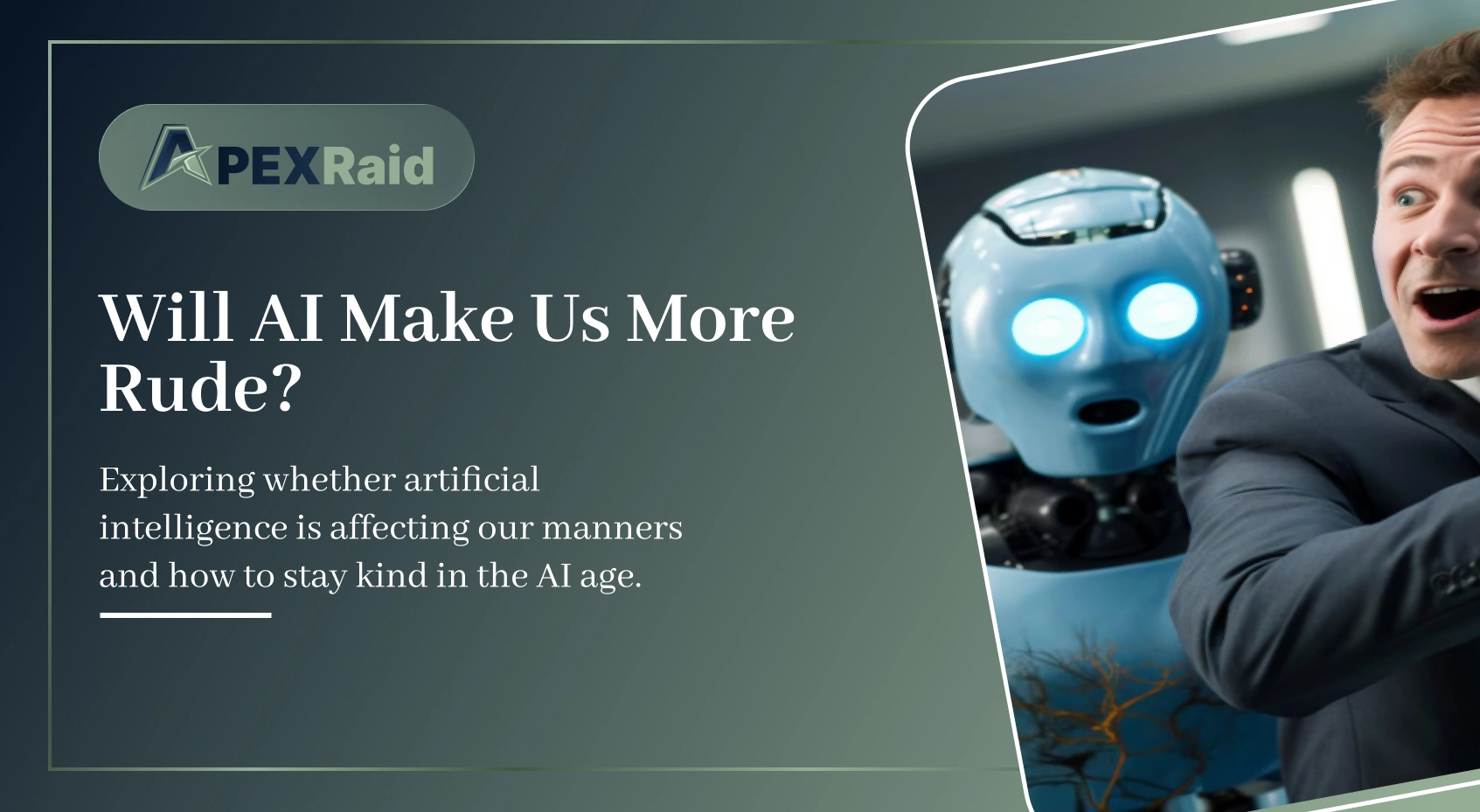
Most of us have gotten used to talking to AI in a very direct way. We ask for a timer, a summary, a draft, or a quick answer, and the system responds right away. It is useful, but the style is different from how we normally speak to people.
That difference matters because habits can spill over. If you spend all day giving short commands to devices, you may start sounding a little more blunt in other conversations too. The shift is often small, so it is easy to miss until someone points it out. A 2026 study published in Communications Psychology formalises this concern through the concept of norm leakage — the cross-context carryover of instrumental communicative habits acquired in human–AI exchanges into subsequent human–human interaction.8†L8-L10
This guide provides a comprehensive, evidence-based analysis of whether and how AI might be changing our communication habits — exploring the research on norm leakage, social deregulation, the erosion of politeness, and practical strategies for maintaining civility in an AI-mediated world.
Why AI Changes the Tone
AI tools do not react like people. They do not get offended, confused, or tired in the same way. That makes them easy to use, but it also makes it easy to get lazy with wording. You do not need to say 'please' to a voice assistant for it to work, so many people stop using softeners altogether.
On its own, that is not a disaster. But when the machine style becomes your default style, it can affect how you deal with real people. The tone you practice the most tends to become the tone that feels normal.
This is not because the AI is teaching bad manners on purpose. It is because the machine removes the social cost that usually nudges us toward courtesy. With people, we naturally adjust. With devices, we often do not bother. A 2026 study in PLOS ONE found that the vast majority of AI prompts contain exactly zero hedges and zero politeness markers.12†L5-L6 Without the threat of social sanction, users perceive these 'social lubricants' as functionally redundant and strip the query down to its logical core, prioritising informational efficiency over interpersonal face-saving.12†L7-L9
The computers are social actors framework, which has anchored human–computer interaction research for decades, holds that individuals carry interpersonal norms — politeness, reciprocity, turn-taking — into exchanges with machines much as they do with other people.8†L22-L24 However, the widespread adoption of large language models challenges the assumption that this arrow runs only one way. Users have adapted by using more direct, command-like language and relying less on hedging or polite framing than they do in human conversation.8†L29-L31 Under such conditions, politeness cues may become instrumentally optional rather than socially expected, creating an interactional environment in which instrumental communication styles are routinely rehearsed.8†L33-L35
The Research on Norm Leakage
Emerging experimental evidence suggests that instrumental habits rehearsed with AI can carry over into how people communicate with and judge other humans. The Communications Psychology study found that in preregistered studies, participants who interacted with an AI partner — rather than a purported human — subsequently adopted more demanding communication styles and evaluated an unrelated person's work more harshly.8†L38-L41 Findings from economic games and cooperation paradigms point to related spillover-like dynamics: interacting with defecting or unfair AI agents can reduce downstream cooperation, suppress third-party punishment of unrelated human wrongdoers, and alter perceptions of humanness in subsequent interpersonal evaluations.8†L42-L45
At issue here is not what AI feels — AI systems cannot be offended — but what repeated interaction does to users over time. When a growing portion of communicative life unfolds in contexts where politeness, reciprocity, and conversational repair are neither required nor rewarded, even small efficiency incentives — accumulated across large numbers of daily interactions — could plausibly contribute to gradual shifts in communicative expectations and interactional habits.8†L46-L52 These observations motivate the concept of norm leakage: the cross-context carryover of communicative habits acquired in human–AI exchanges into subsequent human-directed communication and social judgment.8†L52-L54
Social Deregulation: The Polarisation of User Behaviour
Perhaps the most striking finding from recent research is the phenomenon of social deregulation in AI interactions. The PLOS ONE study found that, without the normative constraints present in human-to-human communication, user behaviour polarises dramatically.12†L27-L29 On one extreme are the 'Commanders' — users who eliminate first-person pronouns entirely, issuing pure imperatives like 'Translate this.'12†L30-L31 On the other extreme are the 'Confessors' — users who use first-person pronouns at extremely high frequencies, treating the AI as a private diary or therapist.12†L31-L33
In human forums, self-presentation is governed by tight social norms: users must introduce their context, but they cannot be excessively narcissistic or purely impersonal. The community norms 'clip' the extremes of behaviour.12†L23-L27 In AI interactions, by contrast, the absence of a 'social gaze' that enforces a standard 'petitioner' role allows user behaviour to diverge into these two distinct modes: purely instrumental command and radical self-expression.12†L40-L42
This polarisation suggests that AI does not simply 'reduce' self-focus or politeness; it facilitates a state of social deregulation where the usual social norms that guide our behaviour are suspended. The majority of users adopt a director stance, but a substantial subset occupies the opposite extreme, leveraging the AI's non-judgmental nature for deeply personal disclosure.12†L33-L37 The concern is that these deregulated habits, once practised extensively with AI, may begin to shape how users communicate with other humans.
Where the Habit Shows Up
You might notice it with customer support, coworkers, or family members. Human conversations are slower and less predictable than AI chats. People pause, explain, forget things, or need a bit of patience. After a day of instant replies from software, that can feel annoying.
Children can pick up the same pattern very quickly. If they watch adults bark commands at devices, they may assume that all requests should sound that way. That is one reason it helps to model polite language even when the device does not require it. Kids learn from tone as much as from words.
The effect does not have to be dramatic to matter. Even a small shift in tone, repeated over time, can change the way a household or workplace feels. A room full of short commands can feel more tense than a room where people still take a second to soften their words.
Research on how politeness toward AI changes over time adds another layer of concern. A 2025 study with 1,684 participants found that politeness toward AI declines over time, with a temporary increase only at the start of a second task.13†L17-L18 Compared to human-human interactions, politeness in human-AI interactions eroded more quickly. Younger participants were less polite overall.13†L19-L20 This suggests that as we become more accustomed to interacting with AI, our inclination to maintain polite communication may steadily diminish — and these habits could carry over into human interactions.
Why Politeness Still Matters
Politeness is not just extra decoration. It tells the other person that you see them as a person. A small amount of courtesy can make a conversation feel calmer and more respectful.
AI is great at speed. People still need warmth. That warmth is often what keeps ordinary interactions from feeling cold or transactional. It is the difference between 'Do this now' and 'Could you help with this?' Both can get the point across, but they do not create the same atmosphere. In a home, office, or support setting, that tone can affect everything from patience to trust. Small words matter more than people think because they set the emotional temperature of a conversation before the actual request even lands.
As Moritz Sahlender argues in an LSE Impact Blog post, speaking to AI dismissively may foster habits that carry over into human interactions.9†L48-L49 Politeness, then, is less about the addressee and more about the kind of person we practice becoming.9†L50-L51 How we speak to AI tools shapes our practices and habits, and retaining a level of humanity in our exchanges with them reverberates across our social interactions.9†L8-L9
Saying 'please' and 'thank you' to AI can be a conscious decision to resist the pressure to communicate like a machine. It is a way of saying that we value more than just efficiency, and that we are not machines ourselves.9†L18-L20
What to Watch For
If you notice your tone getting shorter or harsher in everyday life, it may be worth checking your habits. Maybe you are not becoming rude, exactly. Maybe you are just getting used to the efficiency of AI and forgetting that humans need a little more care.
It helps to ask a simple question: am I talking this way because it is efficient, or because I have started treating every interaction like a command line? That small check can reset your tone before it becomes normal.
It can also help to listen to the people around you. If they seem rushed, flat, or more impatient than usual, they may be feeling the same habit shift. Tone is contagious in both directions.
There is also the question of how AI itself might reinforce these patterns. The Communications Psychology study proposes that sycophantic alignment — where AI systems are trained to be overly compliant and agreeable — may amplify norm leakage by reinforcing instrumental interaction styles.8†L15-L17 When AI always says yes, always complies, and never pushes back, users may come to expect the same level of compliance from the humans around them — an expectation that is both unrealistic and socially corrosive.
Conversely, researchers have proposed that alignment strategies incorporating social boundaries — including a neutral, non-subservient stance, refusal of demeaning frames, and epistemic humility — may help attenuate such spillover, supporting reciprocity and civility in human–human interaction.15†L10-L12
Why This Matters Beyond Manners
This is not only about being polite. It is also about preserving patience. When we get used to instant responses, we can become less tolerant of delay, ambiguity, or awkwardness. Those things are normal in human conversation, but they can start to feel like problems once AI has made everything feel immediate.
The real risk is not a sudden collapse in manners. It is a slow drift toward impatience. Once that happens, even normal human conversation can start to feel heavier than it should. A 2026 article in AI & SOCIETY argues that the hesitation before speaking — the moment where we weigh tone and boundaries, and assume the moral risk of potential misjudgment — is not a linguistic redundancy to be eliminated. It is the very texture of the relational fabric, the signal through which human connection is perceived.14†L11-L13
When this 'manual time' is compressed by algorithms, social ties become dehydrated, flat, and cheap.14†L22-L23 The anxiety of 'What should I say?' and the embarrassment of misspeaking, offending, or appearing rude are not programmatic errors to be eliminated; they are the intrinsic costs of learning boundaries, responsibility, and tact.14†L52-L54 It is through the hesitant pause before speaking that we learn to navigate the complexities of human relationship. When that pause is removed, something essential is lost.
A growing body of research suggests that the impact of AI on our communication habits is not merely speculative. The Communications Psychology perspective concludes that repeated engagement with conversational AI may gradually influence linguistic politeness, directive styles, and interpersonal judgments.11†L58-L59 The question is not whether AI can change how we communicate, but how we can remain aware of that possibility and take steps to protect the civility of our human interactions.
How to Keep the Balance
You do not need to stop using AI or start overthinking every prompt. You just need to keep a clear boundary between machine language and human language. Be direct with the tool if that helps. Be considerate with people even when you are tired or rushed.
That distinction may sound small, but it protects a bigger habit: treating people like people even when technology makes it easy not to. A little courtesy goes a long way. It keeps communication from becoming purely transactional.
One practical trick is to make a habit of adding one softening phrase in everyday messages, even if you do not use it with AI. A simple 'could you,' 'please,' or 'thanks' can be enough to keep the human side of communication alive. If you do use polite language with AI, that choice is not wasted. It reinforces the habit of civility that you want to carry into your human interactions.
As Sahlender observes, speaking politely to AI can be a conscious decision to resist the pressure to communicate like a machine.9†L18-L19 It is a small act of resistance that protects something valuable: the ability to treat others — including ourselves — with the dignity that human connection requires.
Key Takeaway
AI probably will not make us rude by itself, but it can make blunt communication feel normal. The fix is simple: keep the machine style for machines, and keep a human tone for people.
If we stay aware of that difference — and if we understand the emerging research on norm leakage and social deregulation — AI can remain useful without changing the way we treat each other. The habits we practice with machines are the habits we carry into our human relationships. That is a responsibility worth taking seriously.